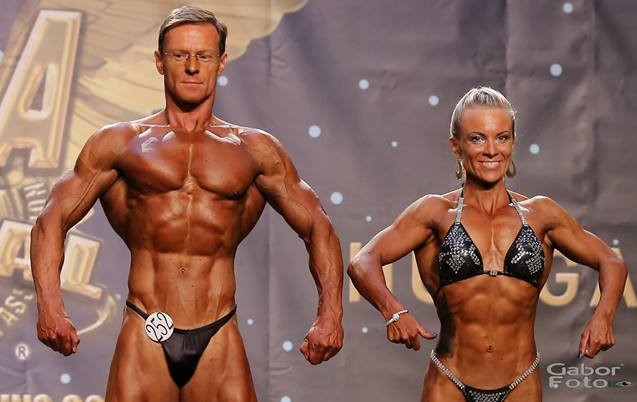
Ten Tips For Those Who Want To Build Muscle....
By Charles R. Taylor
1. Eat Enough
To gain weight and muscle mass is difficult because the body struggles
to keep its weight. To gain mass you need to eat more than your body
requires to maintain its normal functions. You must eat 500 to 1000
extra calories a day to persuade the body to gain more muscle mass.
2. Eat Every Third Hour
You can wait longer between meals, but do you constantly want to be in
an anabolic phase? Your blood sugar should not sink too low, but it will
if you do not eat every 3 to 4 hours. It does not have to be a proper
meal each time you eat. A quick meal or a protein-drink will be enough.
3. Accept a Certain Increase In Body Fat
You have to choose between building muscle or burning fat. You cannot (or
it is very hard to) do this at the same time.
4. Eat a Proper Breakfast
At night, when you are asleep, the body is subversive because you have
not been eating for several hours. This makes breakfast a very important
meal because it stops the cataclysm.
5. Vary the Food
The body can become accustomed to a certain diet. If you eat the same food
for several years you can count on it that your development will stagnate.
Do not let the body become accustomed to your diet.
6. Choose the Right Supplement
There is an unbelievable amount of supplements on the market today. Alot
of them are junk. Only use supplements that you know work. Highly
recommended supplements are creatine and extra protein. There are alot
more supplements from which to choose, but these are the best from which
to start.
7. Get Enough Rest
It has been said that you grow during sleep, and sure it is true.
Do not train more than three days in a row. Some who really want to gain
muscle will only train two or even one day at a time. The results are
often impressive.
8. Train Right
If you are not sure of how to do an exercise, ask someone that is
knowledgeable about the exercise. If you are training incorrectly you will
not grow and your chances of hurting yourself are quite great.
9. Change the Routine
Change your training program every two months. Do not let the muscles
adapt
to the same routine.
10. Make Goals and Achieve Them
To train without a goal is meaningless. Make a goal, for example, to gain
six pounds of muscle mass. Do not give up before you have gained those
extra six pounds. Use all your knowledge about nutrition and training. It
is not only more fun to train with a goal, your progress will also
increase faster. You will be more motivated and you will train and attend
to your diet perfectly.
Lose Fat, Gain Muscle, Shape Up. Sign up for our Free Weekly Bodybuilding,
Fitness and Health Tips Newsletter, and you will be automatically entered
in our monthly drawing to win Free Supplements and other great prizes.
Stay informed, stay motivated, win free stuff, join today!
Click Here To Sign Up Free
Wednesday, January 30, 2008
Saturday, January 26, 2008
The Truth About Antidepressants
88 per cent of clinical trials that showed antidepressant
drugs didn't work either weren't published in medical journals
or were presented as positive findings, says the study in the
New England Journal of Medicine.
Sadly, the $21 billion antidepressant industry is built more
on marketing hype than medical science.
Depressed About Results? Science May Explain It
http://online.wsj.com/article/SB120131395200018827.html?mod=googlenews_wsj
Study Says Patients, Doctors Get Distorted View of Antidepressants
http://online.wsj.com/article/SB120051950205895415.html?mod=googlenews_wsj
Anti-depressants may not work - report
http://money.cnn.com/2008/01/16/news/companies/antidepressants/?postversion=2008011618
Wednesday, January 23, 2008
Abdominal Exercises
Ab Crunches
Ab Crunches are easily performed by lying on your back and placing the
calves on a bench so that the legs are bent at a 90 degree angle to
the floor. Place the hands behind the head and then raise the head
and shoulder blades off of the ground towards the knees. The range
of motion is rather short. It is not necessary to touch the forehead
to the knees as this would require improper form. Perform the ab
crunches slowly and deliberately for the greatest benefit.
Lying Leg Raises
Lying leg raises are an excellent abdominal exercise for the lower
abdominal muscles but will not help you to loose weight. To perform
lying leg raises lye down on your back placing the hands face down
underneath the lower back and rear end for better leverage. Bring
the knees up (bent legged) towards the chin while contracting the
abdominal muscles. Then return the legs to an almost straight legged
position stretching the abdominal muscles. The legs should be just
a few inches off of the floor at the starting point.
V-ups
V-ups are an excellent abdominal exercise that strongly stresses the
lower abdominal muscles. Although V-Ups are an effective abdominal
exercise V-Ups are not for everyone. V-Ups are a more advanced
abdominal exercise.
To perform V-Ups sit at the end of a bench, place the hands face down
under the rear end for leverage, legs should be at 45-90 degree angles
from the floor and the upper body at about a 45-90 degree angle from
the bench. Now bring the knees up to the chest while simultaneously
bringing the chest towards the knees, repeat. The legs and torso
make a v-shape, thereby receiving the name V-Ups.
Lose Fat, Gain Muscle, Shape Up. Sign up for our Free Weekly Bodybuilding,
Fitness and Health Tips Newsletter, and you will be automatically entered
in our monthly drawing to win Free Supplements and other great prizes.
Stay informed, stay motivated, win free stuff, join today!
Click Here To Sign Up Free
Friday, January 18, 2008
The Truth About Psychiatry
"The re-interpretation and eventually eradication of the concept of right and wrong which has been the basis of child training, ...are the belated objectives of practically all effective psychotherapy."
(G. Brock Chisholm, past president, World Federation for Mental Health.)
"If the race is to be freed from its crippling burden of good and evil, it must be psychiatrists who take the original responsibility."
(G. Brock Chisholm, past president, World Federation for Mental Health)
"Even for their own good the blacks must be treated as what they are, an absolutely subordinate, inferior, lower type of men, incapable themselves of culture. That must once and for all be clearly stated."
(August Forel, psychiatrist, quoted in "Bernhardt Schreiber".)
"The mental health establishment has snowed the American people: it launches the most unimaginable brutal psychological and physical assault on human beings in distress, calls this 'medical treatment', and then blames the outcome on 'mental illness'."
(Seth Farber, PhD)
"...In numbers unmatched in any part of the world, U.S. school children are diagnosed and drugged in a quid pro quo association between education and for-profit psychiatry and psychology. Labeled "brain-diseased", the schools have an excuse for the rampant illiteracy and unpreparedness, cause enough for the mounting unhappiness and failure of the children, while psychiatry/psychology gains lifetime patients.
(Thomas Armstrong, Ph.D. educator and psychologist)
Wednesday, January 16, 2008
Pactical Pullups vs. Powerlifting Pullups
By Pavel Tsatsouline
Choose your pullup form to match your goals.
In the military and law enforcement the pullup sets one up for a
muscle-out over an obstacle. The operator needs to get maximally
close to the bar and as high above it as possible. This can only
be achieved when you look straight rather than up and 'hunch over'
on the top of the pullup. This engages powerful muscles in the
front of the rib cage and adds height to the pullup.
When powerlifter Ed Coan does pullups he looks up and arches his
back. This groove brings the body under the bar rather than over
it so is not appropriate for tactical applications. But a
powerlifter is not training to climb fences. He strengthens
his upper back muscles to assist in spine stabilization in
deadlifts and the arch is perfect for that. Besides, the lats
are emphasized in the modern bench press technique. The
'PL pullup' works the lats better then the tactical pullup as
the lats can fully contract only when the back is arched.
Pavel Tsatsouline is the author of "Power to the People!
Russian Strength Training Secrets for Every American"
for full infomation go to http://www.trulyhuge.com/russian.htm
Lose Fat, Gain Muscle, Shape Up. Sign up for our Free Weekly Bodybuilding,
Fitness and Health Tips Newsletter, and you will be automatically entered
in our monthly drawing to win Free Supplements and other great prizes.
Stay informed, stay motivated, win free stuff, join today!
Click Here To Sign Up Free
Wednesday, January 09, 2008
Healthy Eating Tips
By Dr. Kem Thompson
Everyone knows that we have to eat healthily in order to stay
healthy. Yet many people find it hard to do so. One useful
way to get you into the habit of eating healthily is by
applying a few principles to the way you eat. I've
outlined 7 of them below.
I. Eat small portions of food for each meal.
II. Eat frequently. Most adults get hungry about 4 hours after
their last meal.
Aim to eat at least 5 small sized meals each day. This keeps
your metabolic rate high.
III. Eat foods that you enjoy eating, making sure that each
meal contains all the essential nutrients (protein,
carbohydrates, fats, minerals and vitamins).
IV. Eat only when you’re hungry.
V. Stop eating as soon as you feel full: practice pushing
away your plate with food still on it when you’ve had enough.
Don’t aim to wipe the plate clean, and don’t eat until you
feel stuffed. Eat until you’re comfortably satisfied.
VI. Drink a lot of water. Scientists recommend that we drink
roughly 8 (250mls) glasses of water each day.
Water helps you stay full, and if you’re eating only when
you’re hungry, it means you’ll eat less without feeling
like you’re depriving yourself. It also helps you flush
out toxins from your body which otherwise could interfere
with your body’s normal metabolism.
VII. Eating should be a pleasure, not a pain. For any
food plan to work, it has to be practical, enjoyable,
flexible and nutritious. Any plan that's based on
depriving you of some food or other is almost certainly
doomed to fail in the long term.
Try incorporating the above tips into the way you eat.
Start with one of them, practice it for a week (or
until you're used to it), then start on another one.
If you make changes in small steps, you won't be
overwhelmed and easily discouraged by your progress.
So make a small change each time; celebrate (or reward
yourself) for each success, no matter how small you
think it is.
Remember, every baby step is bringing you closer to
your desired goal of being a healthy eater.
With persistence, you will find that eating healthily
is not only possible, but it's fun.
So go for it!
Lose Fat, Gain Muscle, Shape Up. Sign up for our Free Weekly Bodybuilding,
Fitness and Health Tips Newsletter, and you will be automatically entered
in our monthly drawing to win Free Supplements and other great prizes.
Stay informed, stay motivated, win free stuff, join today!
Click Here To Sign Up Free
Wednesday, January 02, 2008
South Beach Diet Review
The South Beach Diet is not a traditional low-carb diet. Instead
it emphasizes the choice of good carbohydrates and good fats.
The South Beach is divided into three phases. In Phase One, most
carbohydrates are banned to give your body a complete rest from
fluctuating blood sugar and insulin levels. The theory is this
will help to resolve insulin resistance.
During Phase One, the banned foods list includes bread, rice,
potatoes, pasta, fruit, milk, sweets, cake, biscuits, ice cream,
sugar and alcohol. A few low GI veg such as broccoli and cabbage
are allowed, but the focus is on eating lean meat, chicken, fish,
eggs, low-fat cheese, some nuts and olive oil.
In Phase Two, low GI carbs including most fruits, Granary bread,
wholegrain cereals and pasta and low-fat milk are reintroduced.
The idea is to stay with this phase until you've reached your
target.
Finally, in Phase Three you introduce an even wider variety of
foods.
South Beach Diet Sample Recipe
Crab Cobb Salad
Phase 1
Serves 2
Ingredients:
6 cups romaine lettuce
6 oz crabmeat
1 cup diced tomatoes
1/4 cup crumbled blue cheese
2 tbsp cholesterol-free bacon bits
1/4 cup olive oil vinaigrette
Directions:
Chill 2 Plates. Arrange the lettuce on a large serving platter.
Arrange the crabmeat, tomatoes, blue cheese, and bacon bits in rows
over the lettuce. Right before serving, drizzle some dressing
evenly over the salad and toss well. Transfer to the 2 chilled
plates.
Lose Fat, Gain Muscle, Shape Up. Sign up for our Free Weekly Bodybuilding,
Fitness and Health Tips Newsletter, and you will be automatically entered
in our monthly drawing to win Free Supplements and other great prizes.
Stay informed, stay motivated, win free stuff, join today!
Click Here To Sign Up Free
Wednesday, December 26, 2007
40-30-30 Nutrition Plan Review
The premise of the 40-30-30 Diet is simple: "Your genes have not
changed very much during the past 100,000 years".
Our body is a biochemical machine, and for hundreds of thousands
of years, our digestive system operated correctly when eating
just 2 food groups:
1. Lean Protein
2. Natural Carbohydrates like fruits and vegetables
Evolution works very slowly, and as far as our genes are concerned,
we are still build to eat those 2 food groups. By evolutionary
standards, agriculture is still relatively recent and therefore
our digestive system has not yet adapted to eating large quantities
of dense, highly processed carbohydrates like grains, pasta and bread.
Because we haven't evolved to a stage where we can properly digest
large amounts of high density carbohydrates, our body experiences
adverse biochemical effects like fat gain, diabetes, heart
disease, sluggish feeling, etc. The 40-30-30 Diet is designed to
feed our body according to its genetic makeup.
What you eat and how you eat has a powerful effect on your body
and health. This diet plan treats food as more than just a source
of calories that must be counted and restricted. It views food
as a powerful agent that has significant effects on our body.
For example, certain foods can cause severe surges in insulin
production. Significant swings in insulin levels can negatively
affect mood, endurance, mental focus, and fat. The 40-30-30
Diet Plan was designed to keep our body balanced and performing
at its peak. It does this by incorporating 4 key elements:
The 40-30-30 Nutrition Plan
The use of mono-unsaturated fats
Supplementation with Omega-3 oils
Exercise
40-30-30 Sample Meals and Snacks Diet Menu
Breakfast: Scrambled Eggs Florentine with cheese and grapes
Snack: Yogurt with raspberries and almonds
Lunch: Chicken Salad Pita Sandwich with asparagus salad
Snack: Turkey and Cheddar Lettuce Wrap
Dinner: Zesty Broiled Fish with couscous
Lose Fat, Gain Muscle, Shape Up. Sign up for our Free Weekly Bodybuilding,
Fitness and Health Tips Newsletter, and you will be automatically entered
in our monthly drawing to win Free Supplements and other great prizes.
Stay informed, stay motivated, win free stuff, join today!
Click Here To Sign Up Free
Wednesday, December 19, 2007
Zone Diet Review
The Zone is achieved when each meal is composed of 40% carbohydrates,
30% proteins and 30% fat. This might sound complicated but it is
actually pretty easy when you follow the Zone Food Block System.
With this system different foods are assigned a food block value.
For example a block of protein is equal to 7 grams, which is about
1 ounce of low-fat cheese. Your gender, activity level and current
percentage of body fat will determine your daily food block
requirements.
Examples of Zone Food Block System
1 Protein Food Block = 7 grams of Protein
1 oz of skinless white meat chicken
1 1/2 oz of salmon
1 oz of beef
1 Carbohydrate Food Block = 9 grams of Carbohydrate
1/2 apple
10 cups romaine lettuce
1 cup butternut squash
1 Fat Food Block = 1.5 grams of Fat
1/3 tsp of canola oil
3 olives
1/2 tsp peanut butter
Sample Free Zone Diet Recipe
Baked Fish and Vegetables
Ingredients:
1 tsp olive oil
4 1/2 oz flounder
Onions, sliced
2 cups yellow squash, sliced
2 cups zucchini, sliced
Lemon juice
Thyme and dill, chopped
1 plum
Directions:
Preheat oven to 400 degrees. Coat bottom of baking dish with oil.
Spread half the vegetables in the dish. Top with fish fillets.
Put the rest of the vegetables on top. Sprinkle lemon juice and
herbs over the mixture plus a couple of grinds of pepper, it
desired. Cover with foil and bake about 45 minutes or until fish
is done and vegetables are tender. Serve with lemon wedges.
Lose Fat, Gain Muscle, Shape Up. Sign up for our Free Weekly Bodybuilding,
Fitness and Health Tips Newsletter, and you will be automatically entered
in our monthly drawing to win Free Supplements and other great prizes.
Stay informed, stay motivated, win free stuff, join today!
Click Here To Sign Up Free
Tuesday, December 18, 2007
Thursday, December 13, 2007
What happens when I stop exercising?
So you have been working out for a while, seeing great results and
loving the difference you see and feel in your body. But what
happens if, for some reason — injury, holidays, burnout, or
something else — you have to stop for a while.
What happens?
Well first, let me tell you what doesn’t happen. Your muscle does
not turn to fat. That would be like saying if you stop driving
your car, your tires will turn to marshmallows. You may lose
muscle mass and gain some fat, but your muscle does not turn to
fat.
Here is what does happen:
Cardio: You begin to lose aerobic endurance in as little as two weeks.
Muscular Strength: Studies have shown that muscular strength will
return to pre-exercise levels after four to 12 weeks off.
Muscular Size: Muscles will shrink after 4-12 weeks off.
Metablism: As your muscles atrophy, your metabolism will slow. This
means that if you eat the same amount, you will gain weight.
The good news is once you start exercising again is all comes back
fairly fast.
Lose Fat, Gain Muscle, Shape Up. Sign up for our Free Weekly Bodybuilding,
Fitness and Health Tips Newsletter, and you will be automatically entered
in our monthly drawing to win Free Supplements and other great prizes.
Stay informed, stay motivated, win free stuff, join today!
Click Here To Sign Up Free
Thursday, December 06, 2007
Muscle Building over 40
By Scott Miller
MYTH: A man over 40 years old can no longer build muscle.
Granted, at 40 years old, men usually have less testosterone
in their systems, but we can still build muscle. It just
takes a bit more persistence and hard work.
If you read all the muscle mags and try to follow what they
say, you might make some gains, but typically you will be
over-trained. So, let's throw all of that away and
concentrate on the things that really matter: training,
nutrition and rest.
Whatever your routine, make sure it's working for you and
you're making progress. After 3-4 weeks of your new
routine, if you're not lifting more or doing more reps,
you should re-think your routine. Remember, there is no
"cookie cutter" routine that works perfectly for everyone,
so if this one doesn't work, change it.
One of the biggest things to remember in your routines
for adding muscle mass is to LIFT HARD and HEAVY! I
can't stress this enough. I've talked to too many guys,
young and old, who proclaim that they can't add any size.
If you watch them, they never really push themselves.
You must always push yourself and strive for more reps
or more poundage or you will never make any quality gains.
Lifting hard and heavy leads us right into a few other
points – your joints and using straps and wraps. Being
over 40 and lifting can pose problems with your joints.
Aside from taking glucosamine and chondroitin (not a bad
idea), stretching frequently before, during and after a
training session is important. Even stretching
during your work day can help keep you limber and
actually relieve some of the soreness and help keep the
joints from getting stiff. If you've got a joint
problem that is persistent, don't try to "man through
it", but go see your doctor and have him make sure you're
OK.
Many exercises can be quite taxing on your grip and your
grip will give out before the muscle you're training will.
In those instances, use straps. You don't want to limit
your muscle growth because your grip gives out. BUT,
make sure you include grip/forearm exercises in your routine.
At our age, knee wraps are probably a good idea, just for
the added support they give. I use a wrap on my right
knee and will be starting on my left knee soon. Be smart.
I do not wear a lifting belt. I used to, but I discovered
that my lower back was just, plain weak. I started doing
good mornings, back extensions, dead lifts and rack dead
lifts. Within a few months, I had no need to wear a belt,
with the exception of near 1RM squats.
Whether younger or older, you need to track your progress.
Whether it's a log book or a piece of paper in your pocket
that you then enter into your computer at home, track your
progress. This will let you know where you're at and
where you've been. At the next workout, you won't be
guessing, you'll have the numbers in front of you.
Setting goals goes hand-in-hand with tracking your
progress. Setting both short-term and long-term goals
is very important and will help keep you focused on your
lifting.
If you're really serious about putting on muscle, then
nutrition is probably 70% of the entire package. You need
to be eating clean foods – not fast foods. At least 5
meals a day is necessary to keep your metabolism going.
6-8 meals a day is not unreasonable, if you have the time.
For us "older guys", building muscle isn't quite as easy
as it used to be, so we have to really concentrate on
what we eat and when. Protein, carbs and fats are all
essential, not only in proper nutrition, but for
building muscle.
Make sure you eat enough to support muscle gain. Most
people, older or younger, that call themselves "hard
gainers", just aren't eating enough. How do you know?
An easy way to figure it out is to write down everything
you eat every day for a week. Get a calorie counting
book and put the numbers to it. Then figure out your BMR.
If your BMR is 2200 calories, then you have to eat more
than that each day to gain, and that's not 2210
calories a day, but 2300+. Granted, there's a balance
between eating an excess and pigging out every day. You
can make muscle gains and keep the body fat at a minimum
if you don't over eat and eat clean food.
Last, but not least, REST.
That's right, rest. 7-8 hours of good, steady sleep is
critical. If you're always tired from not sleeping enough,
not only will your workouts suffer, but nearly everything
else can suffer, as well. A nap, if you have the time,
can be wonderful.
So, you're "Over the Hill", huh? Big deal. If you eat
right, train hard and get good sleep, you can still be
on the front side of the hill, instead of the back side.
I'm bigger and stronger now at 45 years old than I have
ever been.
Lose Fat, Gain Muscle, Shape Up. Sign up for our Free Weekly Bodybuilding,
Fitness and Health Tips Newsletter, and you will be automatically entered
in our monthly drawing to win Free Supplements and other great prizes.
Stay informed, stay motivated, win free stuff, join today!
Click Here To Sign Up Free
Wednesday, November 28, 2007
Tuesday, November 27, 2007
Triming Down for Powerlifters
By Shawn "Bud" Lyte - CME, CSN
President, BMF Sports
Illinois State Chairman, 100% RAW Powerlifting Federation
RawPowerlifting.com
Over the years, unfounded rumors, myths and half-truths have arisen and
taken hold in regards to the detriments of cardio and diet to power
and strength performance. Cardio allegedly drains a powerlifter's power
akin to Superman wearing a Kryptonite codpiece. This is true only if
the cardio is pre-workout, intense, and in excess of 15-20 minutes,
and depends on the subsequent workout. For example, one would not want
to spend 20 minutes on a stepper or hammering on a cycle before their
squat training.
I've found that doing only a light and brief (5 minute) cardio warm up
on squat days helps keep my legs and squats strong for training.
Typically, my trainees, teammates and I will do 20 minutes of
post-workout cardio on bench days and off days, which comes out 3 days
a week on average. For those who only do evening workouts, 20-30
minutes of morning cardio, every other day, works very well.
As far as fat loss, I never rely on or look to cardio as a sole or
primary means to that, preferring diet modification. Approach that
I take with my trainees, that continues to work well, is to drop
calories over the course of 3-4 weeks to about 70% of my maintenance
calories, then hold at 70% until the target weight range is reached.
Example:
wk 1: 9 x bodyweight integer (250 lb) = 2250 calories
wk 2: 8 x bodyweight integer (250 lb) = 2000 calories
wk 3: 7 x bodyweight integer (250 lb) = 1750 calories
>From here, calories are brought (over the course of 3-4 weeks) back
up to 90% which becomes the lifter's new maintenance calorie intake.
The key here is to keep the calories as lean as possible. No
processed foods (except on a cheat day here and there), no saturated
or hydrogenated fats at any time, and always, always, always
consuming protein with carbs.
A lean operation is an efficient one, and the same goes for bodies.
You will find that when you keep your body fat and weight under
control, your training efficiency, metabolic efficiency, and
performance improve considerably, comparatively effortlessly, and
you won't fight yourself caught up in the battle of trying to make
weight.
Lose Fat, Gain Muscle, Shape Up. Sign up for our Free Weekly Bodybuilding,
Fitness and Health Tips Newsletter, and you will be automatically entered
in our monthly drawing to win Free Supplements and other great prizes.
Stay informed, stay motivated, win free stuff, join today!
Click Here To Sign Up Free
Friday, November 23, 2007
Fat Loss Myths
By Gary Matthews
Every regime has its supply of useless folk lore and
half-truths that get passed on down the line from
person to person. But I'd put fat loss up against
any of them for what has to be the most time wasting and
even the most dangerous myths out there.
There is a ton of free advice seen in the media these days
and if it is taken seriously, can really set you back on your
fat loss endeavours. This can lead to the kind of frustration
that makes people think they are "destined to remain fat for life".
This in not true, Have a look at the myths below and draw your
own conclusions.
More exercise is better.
Every exercise session is beneficial to each individual,
however more is not always better. It depends on what is
trying to be achieved. There is a level and frequency
required to achieve results.
After this level is reached, additional exercise can
have the opposite effect, not allowing the body to
recuperate and adapt to the stress induced by the
exercise, which can be detrimental to your results.
After stopping exercise muscle will turn to fat.
This in not possible, Muscle and fat are two different
types of tissues in the body and you cannot convert one into the
other. This is like trying to turn water into milk.
If you stop training, the muscles will shrink
in size - and do not disappear. The more calories
taken in that are not burned off will be deposited as fat.
If you’re not sweating, you’re not working hard enough.
Sweating is the body's way of cooling itself down.
Many factors contribute to body temperature, including
room temperature, types of exercise done, body-fat levels,
clothing, and exercise intensity. The intensity for
exercise can't be judged by the amount you sweat.
A well-trained person will often sweat a lot because
their body can more efficiently regulate heat.
Taking sugar before exercise to raise energy levels.
Ingestion of sugar will lead to a rapid rise in blood
sugar levels. This rapid rise stimulates a release of
insulin, which quickly removes the excess sugar from
the blood system, often causing your blood sugar levels
to drop, sometimes below the level that it started at,
leading to faster exhaustion.
Gaining weight is just a part of getting older.
Getting older is not an excuse for gaining weight!
As we age and begin a more sedentary lifestyle we
start to lose muscle mass.
The efficiency of your metabolism is directly linked
to how much muscle you have on your body. The most
efficient way of maintaining your body's muscle mass
and keeping your metabolism from dropping, is by
doing a high intensity strength training workout once a week.
X is the best form of exercise.
Claims like this are usually based on marketing strategy
and personal bias. Even when claims are based on factual
information, they have little practical value to the
average exerciser. The most important thing is to choose
an activity that you like, and perform it properly and
consistently.
If it’s fat free I can have as much as I want.
Unfortunately fat free doesn't mean calorie free.
The word fat free is misleading because if you
overeat on anything, even fat free foods and you
don't burn off those calories, your body will
store the excess as fat.
Don't drink water when you exercise or you will get cramps.
By drinking litres of icy cold water in one go while
exercising you will probably suffer from cramps.
This is why it is important to drink water
continuously before, during and after exercising
to replace the fluid you've lost and avoid any discomfort.
By not having a personal trainer I wont make gains.
Hiring a personal trainer is one way you can use to
reach your goals, but you are an adult capable of
making decisions and setting your own goals once
you have the knowledge of how to go about it.
Following a good exercise program and eating
plan does not require someone standing over
you and telling you how to do it.
By exercising my abs I will lose my pot belly.
Exercising your abdominals will help to tone and
firm the abdominal region, but it will not reduce
fat deposits that are responsible for a pot belly.
Fat reduction comes from burning more calories
than you take in. Fat is reduced uniformly throughout
the body there is no such thing as spot reduction.
Lose Fat, Gain Muscle, Shape Up. Sign up for our Free Weekly Bodybuilding,
Fitness and Health Tips Newsletter, and you will be automatically entered
in our monthly drawing to win Free Supplements and other great prizes.
Stay informed, stay motivated, win free stuff, join today!
Click Here To Sign Up Free
Wednesday, November 14, 2007
Muscle Gain Myths
By Gary Matthews
Myths that lead to wasted time, frustration and if are taken
blindly as truth, can really set back your progress in the gym.
Don't believe everything you hear in the gym when it comes to
exercise and muscle gain, do the research yourself.
Simple, basic principles apply to all muscle gaining such as
progressive overload, variable frequency of reps and high
intensity workouts. Lets take a look at some of the most
common muscle gain myths.
High repetitions for definition and low repetitions build muscle.
Progressive overload is needed to make muscles bigger. Meaning
that you need to perform more reps than you did for your last
workout for that particular exercise. If you perform the same
amount of reps at each workout nothing will change on you, also
if the poundage on the bar doesn't changes on the bar nothing
will change on you. You need to become stronger.
Definition has two characteristics, muscle size and a low
fat percentage. To reduce fat you will have to reduce your
calories; the high repetition exercise will burn a few calories,
but wouldn't it be better to fast walk to burn these off?
Better still; use the low reps to build muscle, which will
elevate your metabolism and burn more calories.
Vegetarians can't build muscle.
Yes they can! Strength training with supplementation of
soy Protein Isolate has shown to increase muscle. Studies
have shown that athletic performance is not impaired
by following a meat free diet, and people strength training
and consuming only soy protein isolate as a protein source
were able to gain lean muscle mass.
If you take a week off you will lose most of your gains.
Taking one or two weeks off occasionally will not harm your
training. By taking this time off every eight to ten weeks
in between strength training cycles it has the habit of
refreshing you and to heal those small niggling injuries.
By having longer layoffs you do not actually lose muscle fibres,
just volume through not training, any size loss will be quickly
re-gained.
If I'm not sore after a workout, I didn't work out hard enough.
Post workout soreness is not an indication of how good the
exercise or strength training session was for you. The fitter
you are at a certain activity, the less soreness you will
experience after.
Lose Fat, Gain Muscle, Shape Up. Sign up for our Free Weekly Bodybuilding,
Fitness and Health Tips Newsletter, and you will be automatically entered
in our monthly drawing to win Free Supplements and other great prizes.
Stay informed, stay motivated, win free stuff, join today!
Click Here To Sign Up Free
Wednesday, November 07, 2007
Exercise Just as Effective as Medication for Treating Major Depression
Q I was watching Bill Maher on TV and he said a recent study showed
exercise was just as effective for depression as an antidepressant
medication. Was he just kidding? Or is this real?
A It is real all right. The study, published in the journal
Psychosomatic Medicine, comes from Duke University. A professor of
medical psychology, Dr. James Blumenthal, led the research. After
demonstrating that 30 minutes of brisk exercise three times a week
is just as effective as Medication therapy in relieving the symptoms
of major depression in the short term, medical center researchers
have now shown that continued exercise greatly reduces the chances
of the depression returning. Last year, the Duke researchers
reported on their study of 156 older patients diagnosed with major
depression which, to their surprise, found that after 16 weeks,
patients who exercised showed statistically significant and
comparable improvement relative to those who took anti-depression
medication, or those who took the medication and exercised.
Researchers found that aerobic exercise, like brisk walking,
swimming, biking and aerobic dance, works best. It seems to
affect the body’s levels of mood-lifting neurochemicals like
norepinephrine and serotonin. Therefore, if you would rather
exercise your depression away, it’s worth a try. You may get
fit in more ways than one.
These findings could change the way depression is treated,
medications have been proven to have unwanted side effects
and more and more people are looking for a natural way of
feeling better.
Lose Fat, Gain Muscle, Shape Up. Sign up for our Free Weekly Bodybuilding,
Fitness and Health Tips Newsletter, and you will be automatically entered
in our monthly drawing to win Free Supplements and other great prizes.
Stay informed, stay motivated, win free stuff, join today!
Click Here To Sign Up Free
Thursday, November 01, 2007
The Best Muscle Building Exercises
Leg Exercises
Barbell Squats:
Major Muscles Worked-Quadriceps, hamstrings, hips, and glutes.
Leg Press:
Major Muscles Worked-Quadriceps, and hamstrings.
DeadLift:
Major Muscles Worked-Hamstrings, glutes, and lower back.
Leg Extension:
Major Muscles Worked-Quadriceps
Leg Curls:
Major Muscles Worked-Hamstrings
Calf Raises:
Major Muscles Worked- All calf muscles.
Chest Exercises
Bench/Dumbbell Press:
Major Muscles Worked-All Pectorals
Incline Bench/Dumbbell Press:
Major Muscles Worked-Upper Pectorals
Dumbbell Fly:
Major Muscles Worked-All/Inner Pectorals
Back Exercises
Pull-up:
Major Muscles Worked-Lats
Lat Pulldowns:
Major Muscles Worked-Lats and Teres Major
Hyperexyensions:
Major Muscles Worked-Lower Back, Hamstrings, and Glutes
Barbell Rows:
Major Muscles Worked-Lats, Rhomboids, and Teres Major
Shrugs:
Major Muscles Worked-Trapezius
Shoulder Exercises
Military Press:
Major Muscle Worked-Anteroir Deltoids
Lateral Dumbbell Raise:
Major Muscles Worked-All Deltoids
Posterial Lateral Raise:
Major Muscles Worked-Posterial Deltoids
Tricep Exercises
Close-Grip Bench Press:
Major Muscles Worked-Triceps
Tricep Pulldowns:
Major Muscles Worked-Triceps
Bicep Exercises
Barbell Curls:
Major Muscles Worked-Biceps
Incline Dumbbell Curls:
Major Muscles Worked-Biceps
Calves
Standing Calf Raises:
Major Muscles Worked-Total calf area
Abs
Crunches:
Major Muscles Worked-Abdominals
Leg Raises:
Major Muscles Worked-Lower Abdominals
Lose Fat, Gain Muscle, Shape Up. Sign up for our Free Weekly Bodybuilding,
Fitness and Health Tips Newsletter, and you will be automatically entered
in our monthly drawing to win Free Supplements and other great prizes.
Stay informed, stay motivated, win free stuff, join today!
Click Here To Sign Up Free
Subscribe to:
Posts (Atom)
