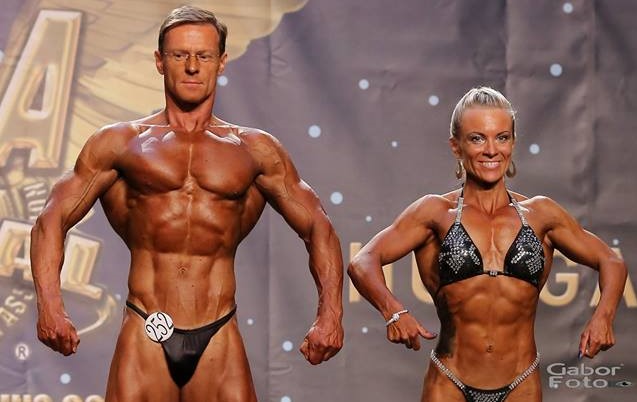
Muscular Weight Gain for my Ectomorphic Friends
Mark DiMaggio, Master Fitness Trainer/Instructor, Sports Nutritionist
& Testing Agent for the IFA, AAPT, & NFPT, Fitness Wellness & Nutrition
Consultant, Corporate Programs Director
The formation of Lean Muscle tissue (Protein Synthesis), takes about 48
hours, if during the "recovery" period, correct eating & resting habits
are adhered to. Where does the 48 hours start? Right after your weight
resistance routine. You must eat immediately after exercise, within 15
to 30 minutes. If I had known this one physiological fact, I am positive
I would have had the muscular body I wanted at about age 14, instead of
age 18. The body's receptors are completely open to accept nutritional
uptake at optimum levels immediately after exercise. Your energy levels
are depleted and in dire need of nutrients to replenish the energy
storage units of the body - your muscles. Muscles are the battery
storage units of the entire body.
You must eat a meal that has sufficient amounts of Carbohydrates and
Protein after workouts. If you just eat high protein foods, your body
is forced to use proteins for energy. This stresses the liver & kidneys,
along with energy levels. Protein takes anywhere from 3 to 4 hours to be
converted to an energy source, but Carbohydrates replenish your energy
stores more rapidly, in only about 20 to 40 minutes, and "Spare" your
Protein for the process of protein synthesis, the actual building of
lean muscle tissue. You need at least 20 grams of Protein and 30 grams
of Carbohydrates at each meal, 5 to 6 times a day.
If you want to gain the most amount of muscle in the shortest time,
you must learn to eat by "Timing Your Meals," instead of eating when
it is convenient or when you are hungry. The reason is simple, because
your Liver searches the blood stream for "complete chains" of amino
acids every 3 to 4 hours. If all of the essential amino acids are in
place (circulating in your blood stream TOGETHER), the liver will convert
these "Complete Proteins" into new muscle tissue. If one or more of the
essential amino acid chain is not in the blood stream, the liver
stresses. Now the most active organ in the body (the liver performs 64
vital functions daily, and is as active as the heart during sleep) has
to go into the amino acid storage units of the body (muscle tissue), to
extract the missing amino acids to complete the essential-chain. If the
missing amino acids are not readily available, or in low supply, protein
synthesis will not be completed. To add insult to injury, the existing
incomplete amino acid chain is then passed through the body and excreted
as "wastes" never to be used again, a process called deamination. All
that work by the liver, and no results. Carbohydrates are not to be
avoided! They are your best friends when it comes to "Protein Sparing".
If the routine stimulates your white fast-twitch muscle cords (the
strength cords of muscle), the growth will be more pronounced than the
red fast-twitch (intermediate), or red slow-twitch (endurance), muscle
cords. So it makes sense to utilize exercises that stimulate the largest
muscle groups with sufficient weight resistance enabling you to perform
6 to 12 repetitions per set before muscle fatigue causes you to end the
set (this is not "exhaustion," simply the beginning of a muscle "burn"
prior to exhaustion).
Performing 4 to 5 sets per muscle group 2 times per/week per-body part,
will stimulate rapid growth, or hypertrophy (muscle mass development).
Resting at least 3 days after your weight-resistance workout insures
that your muscle tissue has healed completely, and takes you out of
the risk zone of joint & tendon damage, the #1 side effect of
over-training. The white fast-twitch muscle cord burns the greatest
amount of energy, and grows at the fastest rate compared to the 2
other muscle-twitch fibers, but if over-trained, there will be no
growth, just a constant feeling of fatigue with no results.
Try to consume 20 to 35 grams of Protein @ each meal along with 30
grams of low Glycemic Carbohydrates and only 7 to 9 grams of fats at
each meal. If you are going to overeat, make sure the largest portion
of your binge is a good protein source.
Based on your weight, For Example: (170 lbs.), height, (6'1'), and
body-fat (9%), your LBW (Lean Body Weight) is 154.7 lbs. This means your
Basal Metabolic Rate (the lowest amount of calories you can "exist" on
daily) is 1701 calories. Your body always burns much more than that daily
such as Work, Exercise, & Leisure expenditures. You need an overage of
good calories (foods high in nutrients) to create Lean Muscle tissue.
Let's start with the amounts listed below.
Calorie Content For Each Meal
Protein: 100 to 200+ calories (+ or more +)
Carbohydrates: 120 to 150 calories
Fat: 60 to 80 calories (- or less -)
Total Calories each Meal: 350 to 450
Meals Each Day: 5 to 6 per/day
Total Calories Consumed Daily: 2500 to 3000 calories
Lose Fat, Gain Muscle, Shape Up. Sign up for our Free Weekly Bodybuilding,
Fitness and Health Tips Newsletter, and you will be automatically entered
in our monthly drawing to win Free Supplements and other great prizes.
Stay informed, stay motivated, win free stuff, join today!
Click Here To Sign Up Free
Wednesday, March 12, 2008
Wednesday, March 05, 2008
Some Basic Rules
In order to achieve the maximum benefits and to train effectively
and safely, always observe these principles:
Warm Up & Cool Down:
This cannot be stressed enough. Most workout-related injuries can
be avoided by proper warm-up and cool-down. Your muscles need a 5
to 15 minute warm-up as well as a brief cool-down. This holds true
for all weight training workouts.
Start At The Appropriate Level:
If you begin training at to high a level you risk serious injury.
You will also develop poor form, which will hinder your efforts
and discourage you. Use this as a guideline: If you cannot lift
the weight your working with 10 times with proper form, the weight
is too heavy. Similarly, don't choose too light a weight; the last
2-3 repetitions of your set should be difficult.
Proper Technique:
To get the most out of training and to reduce the chance of injury,
use proper lifting techniques. These include working with your
muscles through their full range of motion (Not locking out any
joints), lifting at a speed at which you can control the weight
and easily stop if necessary, and maintaining good posture.
Exercise Large Muscles First:
You should work your large muscle groups first-your chest, back,
and legs - before you exercise your biceps, triceps and smaller
muscle groups. Because our bodies naturally recruit large muscle
fibers first, these muscles will be the first to fatigue.
Progress Gradually:
Increase reps before increasing resistance. Reduce rest interval
between sets to increase workload.
Breath Correctly:
Do no hold you breath. Exhale at the moment of highest effort.
Challenge Your Muscles:
All training should begin progressively, using increases in weight
until your goals or a plateau are reached. Then, change your workout
to include increased reps with lowered weights at the end of a set,
change the order of exercise, or add sets, etc., to reach new goals.
(workouts should change about every 6-weeks).
Give Your Muscles & Mind A Rest:
You'll get the most out of your training if you give your muscles at
least 48 hours rest between weight training workouts to recover and
rebuild.
Lose Fat, Gain Muscle, Shape Up. Sign up for our Free Weekly Bodybuilding,
Fitness and Health Tips Newsletter, and you will be automatically entered
in our monthly drawing to win Free Supplements and other great prizes.
Stay informed, stay motivated, win free stuff, join today!
Click Here To Sign Up Free
In order to achieve the maximum benefits and to train effectively
and safely, always observe these principles:
Warm Up & Cool Down:
This cannot be stressed enough. Most workout-related injuries can
be avoided by proper warm-up and cool-down. Your muscles need a 5
to 15 minute warm-up as well as a brief cool-down. This holds true
for all weight training workouts.
Start At The Appropriate Level:
If you begin training at to high a level you risk serious injury.
You will also develop poor form, which will hinder your efforts
and discourage you. Use this as a guideline: If you cannot lift
the weight your working with 10 times with proper form, the weight
is too heavy. Similarly, don't choose too light a weight; the last
2-3 repetitions of your set should be difficult.
Proper Technique:
To get the most out of training and to reduce the chance of injury,
use proper lifting techniques. These include working with your
muscles through their full range of motion (Not locking out any
joints), lifting at a speed at which you can control the weight
and easily stop if necessary, and maintaining good posture.
Exercise Large Muscles First:
You should work your large muscle groups first-your chest, back,
and legs - before you exercise your biceps, triceps and smaller
muscle groups. Because our bodies naturally recruit large muscle
fibers first, these muscles will be the first to fatigue.
Progress Gradually:
Increase reps before increasing resistance. Reduce rest interval
between sets to increase workload.
Breath Correctly:
Do no hold you breath. Exhale at the moment of highest effort.
Challenge Your Muscles:
All training should begin progressively, using increases in weight
until your goals or a plateau are reached. Then, change your workout
to include increased reps with lowered weights at the end of a set,
change the order of exercise, or add sets, etc., to reach new goals.
(workouts should change about every 6-weeks).
Give Your Muscles & Mind A Rest:
You'll get the most out of your training if you give your muscles at
least 48 hours rest between weight training workouts to recover and
rebuild.
Lose Fat, Gain Muscle, Shape Up. Sign up for our Free Weekly Bodybuilding,
Fitness and Health Tips Newsletter, and you will be automatically entered
in our monthly drawing to win Free Supplements and other great prizes.
Stay informed, stay motivated, win free stuff, join today!
Click Here To Sign Up Free
Wednesday, February 27, 2008
"Push, Pull, Legs: Hulkster’s Workout Routine"
By Gary "Hulkster Jr."
The Push, Pull, Legs technique is based on focusing efforts on either
Pushing away from the center of your body, or Pulling toward your center.
To utilize this technique you perform Push exercises on day one. Day
two, alternate to Pull exercises. Day three work the legs and the
abdominals. This technique is most effective when two cycles of Push,
Pull, Legs are completed each week. That is, six workout days, at 60
minutes a session, and one day of rest.
Results from natural clients show an increase in strength an average of
25% after two months. This includes clients following the basic rules of
rest/recuperation, diet, and supplementation.
To begin the program utilize light weights and focus on technique.
Ensure your form for every exercise is proper. Slowly increase the
weight lifted as you become more familiar with the Push, Pull, Legs
technique. To ensure you are utilizing the correct weight load for your
fitness level, consider the following: when you wake up the next day,
you should be slightly sore. If your muscles are sore throughout the day,
your weight load needs to be decreased. If you wake up the next day and
are not sore, then increase the weight load. Generally the percentage of
decrease or increase is 10-20% of the current weight so as to gradually
build or decrease your weight load.
For body builders with primary goals to dramatically increase their size
and strength, utilize a program of 4 sets per exercise with repetitions of
12, 10, 8, 6, respectively. For the hard gainers utilize the 4 sets per
exercise with repetitions of 10, 8, 6, 4, respectively. Steadily increase
the weight load with each set.
If you do not experience muscle fatigue by last repetition of set 3, you
need to add more weight. Pay particular attention to muscle fatigue on the
last two sets.
Examples of Push Exercises:
Bench Press, Incline Bench Press, Parallel Bar Dips
Press Behind Neck, Seated Dumbbell Press
Tricep Pressdown, Dumbbell Triceps Extension
Examples of Pull Exercises:
Chin Up, Front Lat Pull Down, Low Pulley Rows
Barbell Curl, Incline Dumbbell Curls, Concentration Curls
Barbell Shrugs
Examples of Leg and Abdominal exercises:
Squats, Leg Curls, Thigh Extensions
Standing Calf Raise, Seated Calf Raise
Ab Crunches, Hanging Leg Raise
Lose Fat, Gain Muscle, Shape Up. Sign up for our Free Weekly Bodybuilding,
Fitness and Health Tips Newsletter, and you will be automatically entered
in our monthly drawing to win Free Supplements and other great prizes.
Stay informed, stay motivated, win free stuff, join today!
Click Here To Sign Up Free
By Gary "Hulkster Jr."
The Push, Pull, Legs technique is based on focusing efforts on either
Pushing away from the center of your body, or Pulling toward your center.
To utilize this technique you perform Push exercises on day one. Day
two, alternate to Pull exercises. Day three work the legs and the
abdominals. This technique is most effective when two cycles of Push,
Pull, Legs are completed each week. That is, six workout days, at 60
minutes a session, and one day of rest.
Results from natural clients show an increase in strength an average of
25% after two months. This includes clients following the basic rules of
rest/recuperation, diet, and supplementation.
To begin the program utilize light weights and focus on technique.
Ensure your form for every exercise is proper. Slowly increase the
weight lifted as you become more familiar with the Push, Pull, Legs
technique. To ensure you are utilizing the correct weight load for your
fitness level, consider the following: when you wake up the next day,
you should be slightly sore. If your muscles are sore throughout the day,
your weight load needs to be decreased. If you wake up the next day and
are not sore, then increase the weight load. Generally the percentage of
decrease or increase is 10-20% of the current weight so as to gradually
build or decrease your weight load.
For body builders with primary goals to dramatically increase their size
and strength, utilize a program of 4 sets per exercise with repetitions of
12, 10, 8, 6, respectively. For the hard gainers utilize the 4 sets per
exercise with repetitions of 10, 8, 6, 4, respectively. Steadily increase
the weight load with each set.
If you do not experience muscle fatigue by last repetition of set 3, you
need to add more weight. Pay particular attention to muscle fatigue on the
last two sets.
Examples of Push Exercises:
Bench Press, Incline Bench Press, Parallel Bar Dips
Press Behind Neck, Seated Dumbbell Press
Tricep Pressdown, Dumbbell Triceps Extension
Examples of Pull Exercises:
Chin Up, Front Lat Pull Down, Low Pulley Rows
Barbell Curl, Incline Dumbbell Curls, Concentration Curls
Barbell Shrugs
Examples of Leg and Abdominal exercises:
Squats, Leg Curls, Thigh Extensions
Standing Calf Raise, Seated Calf Raise
Ab Crunches, Hanging Leg Raise
Lose Fat, Gain Muscle, Shape Up. Sign up for our Free Weekly Bodybuilding,
Fitness and Health Tips Newsletter, and you will be automatically entered
in our monthly drawing to win Free Supplements and other great prizes.
Stay informed, stay motivated, win free stuff, join today!
Click Here To Sign Up Free
Wednesday, February 20, 2008
Barbell Pullovers
By The Doctor
In the days of yore (which is anything before the late fifties in
the bodybuilding world) doing heavy barbell pullovers was a rite of
passage into bodybuilding manhood. In fact, I read a quote from the
great George Turner that made me chuckle on reading it. He said that
if you were not able to use 250 pounds on the pullover then you were
nothing. Many lifters years ago said that this exercise would be all
that one needed to get a complete upper body workout. Although I do
not see people use this lift often, I must say that 250 pounds would
be rather heavy. Nevertheless, this exercise is on the verge of
becoming extinct. I tried it to see if it was worth bringing back to
the forefront of resistance-training exercises.
A Little Bit about the Pullover
As mentioned previously, this exercise is considered by many to be
the best upper body exercise.
Some people lie across a bench sideways and others lie on the bench
in a regular fashion and perform them. Usually the trainees will
have their preference of dumbbells or barbells. The variables of
body positioning and equipment to use is up to personal preference.
One advantage that is clear is that it removes the weak link of
back work - the biceps - and allows for more direct lat work. The
pullover is also great for those who are into pre-exhaustion
methods or those who want something to use immediately after
high-repetition squats.
What muscles does this exercise work?
Not only do pullovers work the latissimus dorsi but it also targets
the posterior deltoid, the long head of the triceps, rhomboids,
pectoralis major rather well. In addition, it works the following
muscles in a less direct manner: the anterior deltoid, triceps
brachii and wrist flexors.
I do know a few people who have used this exercise and stated that
their triceps were thouroughly worked on completion. What confused
them was that this was not their intended purpose.
How to do it...
Simply lay your back perpendicularly across a bench and grab a
barbell from behind you and bring it to your chest. Then proceed
to extend your arms to where the barbell is above your chest and
your arms are straightened. You have the option of bending your
elbows from there. Lower the barbell or dumbbell behind and past
your head so as your upper arms are parallel or slightly below
parallel to your torso.
Bring the bar back to your chest and repeat the motion until
muscular failure.
I have used this exercise recently and I must say that it is an
excellent addition to my back work when used as my main
latissimus dorsi exercise. I have not used it for pre-exhaustion
yet, but I plan to use it in combination with chins when I do.
This will remove the biceps as the weak link as my back has always
been my least-responsive muscle. It is an upper body exercise so
I would recommend a repetition range from 6 to 10. As with every
other exercise, if you respond better to other repetition ranges,
then by all means use them.
Lose Fat, Gain Muscle, Shape Up. Sign up for our Free Weekly Bodybuilding,
Fitness and Health Tips Newsletter, and you will be automatically entered
in our monthly drawing to win Free Supplements and other great prizes.
Stay informed, stay motivated, win free stuff, join today!
Click Here To Sign Up Free
By The Doctor
In the days of yore (which is anything before the late fifties in
the bodybuilding world) doing heavy barbell pullovers was a rite of
passage into bodybuilding manhood. In fact, I read a quote from the
great George Turner that made me chuckle on reading it. He said that
if you were not able to use 250 pounds on the pullover then you were
nothing. Many lifters years ago said that this exercise would be all
that one needed to get a complete upper body workout. Although I do
not see people use this lift often, I must say that 250 pounds would
be rather heavy. Nevertheless, this exercise is on the verge of
becoming extinct. I tried it to see if it was worth bringing back to
the forefront of resistance-training exercises.
A Little Bit about the Pullover
As mentioned previously, this exercise is considered by many to be
the best upper body exercise.
Some people lie across a bench sideways and others lie on the bench
in a regular fashion and perform them. Usually the trainees will
have their preference of dumbbells or barbells. The variables of
body positioning and equipment to use is up to personal preference.
One advantage that is clear is that it removes the weak link of
back work - the biceps - and allows for more direct lat work. The
pullover is also great for those who are into pre-exhaustion
methods or those who want something to use immediately after
high-repetition squats.
What muscles does this exercise work?
Not only do pullovers work the latissimus dorsi but it also targets
the posterior deltoid, the long head of the triceps, rhomboids,
pectoralis major rather well. In addition, it works the following
muscles in a less direct manner: the anterior deltoid, triceps
brachii and wrist flexors.
I do know a few people who have used this exercise and stated that
their triceps were thouroughly worked on completion. What confused
them was that this was not their intended purpose.
How to do it...
Simply lay your back perpendicularly across a bench and grab a
barbell from behind you and bring it to your chest. Then proceed
to extend your arms to where the barbell is above your chest and
your arms are straightened. You have the option of bending your
elbows from there. Lower the barbell or dumbbell behind and past
your head so as your upper arms are parallel or slightly below
parallel to your torso.
Bring the bar back to your chest and repeat the motion until
muscular failure.
I have used this exercise recently and I must say that it is an
excellent addition to my back work when used as my main
latissimus dorsi exercise. I have not used it for pre-exhaustion
yet, but I plan to use it in combination with chins when I do.
This will remove the biceps as the weak link as my back has always
been my least-responsive muscle. It is an upper body exercise so
I would recommend a repetition range from 6 to 10. As with every
other exercise, if you respond better to other repetition ranges,
then by all means use them.
Lose Fat, Gain Muscle, Shape Up. Sign up for our Free Weekly Bodybuilding,
Fitness and Health Tips Newsletter, and you will be automatically entered
in our monthly drawing to win Free Supplements and other great prizes.
Stay informed, stay motivated, win free stuff, join today!
Click Here To Sign Up Free
Tuesday, February 19, 2008
Wednesday, February 13, 2008
Daily Aerobic Activity is a Must
Regular aerobic activity should be included into everyone’s daily
routine to strengthen the heart and lungs and make them work more
efficiently. Aerobic activity can include running, walking, stair
climbing, dancing, swimming, or any number of other activities that
get the heart working harder for a continuous period of time. Many
people may feel that they need to have a regimented work out program,
and if they do not have at least thirty minutes to an hour to devote
that they can’t do it. This is simply not true, and in fact, this
type of mentality hinders their progress and keeps them from getting
into shape with regular exercise. Short bursts of aerobic activity
can be fit in throughout the day. Take the stairs instead of the
elevator, take a brisk walk around the building at lunch time, ride
a bike or walk to work if within a reasonable distance, or park
further away to get a short walk in.
The benefits of aerobic activity are many, and everyone of all ages
should be encouraged to engage in regular exercise. Even if there
are chronic health conditions present, regular aerobic activity can
be tailored to fit the individual’s needs. A health care provider
should be consulted before beginning any type of exercise program,
and if excessive shortness of breath or chest pain is present,
then the activity should be stopped immediately. Starting out at
a slower pace is recommended for all beginners anyway until some
tolerance is built up, which will happen over time with regular
aerobic activity.
Regular aerobic activity should put the heart in the cardio
target zone, which is computed by subtracting age from 220. This
number of then multiplied by 85%, the result being the maximum
rate at which the heart should beating during aerobic activity.
Beginners should only work out at 70-75% their target heart
rate until their bodies become more accustomed to higher
aerobic activity levels. It’s good to start out slow and
gradually increase aerobic activity as tolerated, maybe with
just a walk around the block. Any amount of aerobic activity
is better than nothing, so get moving! No excuses!
Lose Fat, Gain Muscle, Shape Up. Sign up for our Free Weekly Bodybuilding,
Fitness and Health Tips Newsletter, and you will be automatically entered
in our monthly drawing to win Free Supplements and other great prizes.
Stay informed, stay motivated, win free stuff, join today!
Click Here To Sign Up Free
Regular aerobic activity should be included into everyone’s daily
routine to strengthen the heart and lungs and make them work more
efficiently. Aerobic activity can include running, walking, stair
climbing, dancing, swimming, or any number of other activities that
get the heart working harder for a continuous period of time. Many
people may feel that they need to have a regimented work out program,
and if they do not have at least thirty minutes to an hour to devote
that they can’t do it. This is simply not true, and in fact, this
type of mentality hinders their progress and keeps them from getting
into shape with regular exercise. Short bursts of aerobic activity
can be fit in throughout the day. Take the stairs instead of the
elevator, take a brisk walk around the building at lunch time, ride
a bike or walk to work if within a reasonable distance, or park
further away to get a short walk in.
The benefits of aerobic activity are many, and everyone of all ages
should be encouraged to engage in regular exercise. Even if there
are chronic health conditions present, regular aerobic activity can
be tailored to fit the individual’s needs. A health care provider
should be consulted before beginning any type of exercise program,
and if excessive shortness of breath or chest pain is present,
then the activity should be stopped immediately. Starting out at
a slower pace is recommended for all beginners anyway until some
tolerance is built up, which will happen over time with regular
aerobic activity.
Regular aerobic activity should put the heart in the cardio
target zone, which is computed by subtracting age from 220. This
number of then multiplied by 85%, the result being the maximum
rate at which the heart should beating during aerobic activity.
Beginners should only work out at 70-75% their target heart
rate until their bodies become more accustomed to higher
aerobic activity levels. It’s good to start out slow and
gradually increase aerobic activity as tolerated, maybe with
just a walk around the block. Any amount of aerobic activity
is better than nothing, so get moving! No excuses!
Lose Fat, Gain Muscle, Shape Up. Sign up for our Free Weekly Bodybuilding,
Fitness and Health Tips Newsletter, and you will be automatically entered
in our monthly drawing to win Free Supplements and other great prizes.
Stay informed, stay motivated, win free stuff, join today!
Click Here To Sign Up Free
Thursday, February 07, 2008
Use Dumbbells To Stretch Your Muscles To New Growth
In this high-tech, high-poundage day and age, dumbbells are often the
forgotten tools of mass training. I notice more and more individuals
at the gym using machines with limited ranges of motion or sticking
with the heavy poundage promise of good old barbell training.
For many, if they pick up a dumbbell at all, it’s to move it out of the
way. Oh, they may throw in a few seated curls or some side laterals every
now and then, but these usually come after their "heavy" sets.
If you’re only using dumbbells for biceps and/or shoulder work, you’re
missing out on a truly time-tested piece of equipment. In fact, I’ve
been making some great gains by taking two or three days a month and
using nothing but dumbbell movements. Here are four of my favorites.
FLYE: You can build fairly large pecs with barbell pressing movements,
and you can develop some decent shape with cables and machines; but if
you’re after full, clearly defined, muscular pecs, you’ll want to get
your dumbbell sets in.
I love training chest using dumbbells, and there’s nothing better for
stretching those pecs to some serious new growth than Dumbbell Flyes.
Flat Bench, Incline, Decline — I use them all (though not during the
same session).
The key to doing flyes successfully is control. Lower the weights with
only slightly bent elbows. Throw your chest up towards the ceiling to
really emphasize a full stretch at the bottom of the rep.
As you bring the weight up, concentrate on pulling your pecs together.
Use light weights at first until you’re used to doing the movement with
the emphasis entirely on your pecs. And never smash the weights together
at the top—pull them together and squeeze your pecs tight for a count
of two.
Pull-Over: Another great dumbbell movement for the pecs. I do this
exercise across a flat bench, and I keep my arms as straight as possible
throughout the entire range of motion. Again, getting a full stretch is
the key to stimulating muscle fibers for new growth and added definition.
With pull-overs I tend to like the 10-15 rep range. It’s important not
to turn this exercise into a lat workout or a lying triceps extension.
Keep your arms straight and focus on using the muscles in the chest to
pull the weight to the eye-level position.
Lying Triceps Extensions: Yes, with dumbbells! The exercise is done in
a similar way to the E-Z Curl or Straightbar French Press version.
Lying on a flat bench, you begin with your arms extended above you.
Slowly lower both dumbbells simultaneously by bending at the elbows.
Be sure to keep your upper arms perfectly straight and still.
Then simply push the dumbbells up and lockout at the top, squeezing
your triceps as you do. I find that using dumbbells with this exercise
from time to time, forces me to maintain perfect form and really
blasts my triceps. And the stretch I get is absolutely intense!
Be sure to give these movements a try and let me know what you think.
Above all, don’t forget about those dumbbells over on that rack in
the corner.
Lose Fat, Gain Muscle, Shape Up. Sign up for our Free Weekly Bodybuilding,
Fitness and Health Tips Newsletter, and you will be automatically entered
in our monthly drawing to win Free Supplements and other great prizes.
Stay informed, stay motivated, win free stuff, join today!
Click Here To Sign Up Free
In this high-tech, high-poundage day and age, dumbbells are often the
forgotten tools of mass training. I notice more and more individuals
at the gym using machines with limited ranges of motion or sticking
with the heavy poundage promise of good old barbell training.
For many, if they pick up a dumbbell at all, it’s to move it out of the
way. Oh, they may throw in a few seated curls or some side laterals every
now and then, but these usually come after their "heavy" sets.
If you’re only using dumbbells for biceps and/or shoulder work, you’re
missing out on a truly time-tested piece of equipment. In fact, I’ve
been making some great gains by taking two or three days a month and
using nothing but dumbbell movements. Here are four of my favorites.
FLYE: You can build fairly large pecs with barbell pressing movements,
and you can develop some decent shape with cables and machines; but if
you’re after full, clearly defined, muscular pecs, you’ll want to get
your dumbbell sets in.
I love training chest using dumbbells, and there’s nothing better for
stretching those pecs to some serious new growth than Dumbbell Flyes.
Flat Bench, Incline, Decline — I use them all (though not during the
same session).
The key to doing flyes successfully is control. Lower the weights with
only slightly bent elbows. Throw your chest up towards the ceiling to
really emphasize a full stretch at the bottom of the rep.
As you bring the weight up, concentrate on pulling your pecs together.
Use light weights at first until you’re used to doing the movement with
the emphasis entirely on your pecs. And never smash the weights together
at the top—pull them together and squeeze your pecs tight for a count
of two.
Pull-Over: Another great dumbbell movement for the pecs. I do this
exercise across a flat bench, and I keep my arms as straight as possible
throughout the entire range of motion. Again, getting a full stretch is
the key to stimulating muscle fibers for new growth and added definition.
With pull-overs I tend to like the 10-15 rep range. It’s important not
to turn this exercise into a lat workout or a lying triceps extension.
Keep your arms straight and focus on using the muscles in the chest to
pull the weight to the eye-level position.
Lying Triceps Extensions: Yes, with dumbbells! The exercise is done in
a similar way to the E-Z Curl or Straightbar French Press version.
Lying on a flat bench, you begin with your arms extended above you.
Slowly lower both dumbbells simultaneously by bending at the elbows.
Be sure to keep your upper arms perfectly straight and still.
Then simply push the dumbbells up and lockout at the top, squeezing
your triceps as you do. I find that using dumbbells with this exercise
from time to time, forces me to maintain perfect form and really
blasts my triceps. And the stretch I get is absolutely intense!
Be sure to give these movements a try and let me know what you think.
Above all, don’t forget about those dumbbells over on that rack in
the corner.
Lose Fat, Gain Muscle, Shape Up. Sign up for our Free Weekly Bodybuilding,
Fitness and Health Tips Newsletter, and you will be automatically entered
in our monthly drawing to win Free Supplements and other great prizes.
Stay informed, stay motivated, win free stuff, join today!
Click Here To Sign Up Free
Tuesday, February 05, 2008
Wednesday, January 30, 2008
Ten Tips For Those Who Want To Build Muscle....
By Charles R. Taylor
1. Eat Enough
To gain weight and muscle mass is difficult because the body struggles
to keep its weight. To gain mass you need to eat more than your body
requires to maintain its normal functions. You must eat 500 to 1000
extra calories a day to persuade the body to gain more muscle mass.
2. Eat Every Third Hour
You can wait longer between meals, but do you constantly want to be in
an anabolic phase? Your blood sugar should not sink too low, but it will
if you do not eat every 3 to 4 hours. It does not have to be a proper
meal each time you eat. A quick meal or a protein-drink will be enough.
3. Accept a Certain Increase In Body Fat
You have to choose between building muscle or burning fat. You cannot (or
it is very hard to) do this at the same time.
4. Eat a Proper Breakfast
At night, when you are asleep, the body is subversive because you have
not been eating for several hours. This makes breakfast a very important
meal because it stops the cataclysm.
5. Vary the Food
The body can become accustomed to a certain diet. If you eat the same food
for several years you can count on it that your development will stagnate.
Do not let the body become accustomed to your diet.
6. Choose the Right Supplement
There is an unbelievable amount of supplements on the market today. Alot
of them are junk. Only use supplements that you know work. Highly
recommended supplements are creatine and extra protein. There are alot
more supplements from which to choose, but these are the best from which
to start.
7. Get Enough Rest
It has been said that you grow during sleep, and sure it is true.
Do not train more than three days in a row. Some who really want to gain
muscle will only train two or even one day at a time. The results are
often impressive.
8. Train Right
If you are not sure of how to do an exercise, ask someone that is
knowledgeable about the exercise. If you are training incorrectly you will
not grow and your chances of hurting yourself are quite great.
9. Change the Routine
Change your training program every two months. Do not let the muscles
adapt
to the same routine.
10. Make Goals and Achieve Them
To train without a goal is meaningless. Make a goal, for example, to gain
six pounds of muscle mass. Do not give up before you have gained those
extra six pounds. Use all your knowledge about nutrition and training. It
is not only more fun to train with a goal, your progress will also
increase faster. You will be more motivated and you will train and attend
to your diet perfectly.
Lose Fat, Gain Muscle, Shape Up. Sign up for our Free Weekly Bodybuilding,
Fitness and Health Tips Newsletter, and you will be automatically entered
in our monthly drawing to win Free Supplements and other great prizes.
Stay informed, stay motivated, win free stuff, join today!
Click Here To Sign Up Free
By Charles R. Taylor
1. Eat Enough
To gain weight and muscle mass is difficult because the body struggles
to keep its weight. To gain mass you need to eat more than your body
requires to maintain its normal functions. You must eat 500 to 1000
extra calories a day to persuade the body to gain more muscle mass.
2. Eat Every Third Hour
You can wait longer between meals, but do you constantly want to be in
an anabolic phase? Your blood sugar should not sink too low, but it will
if you do not eat every 3 to 4 hours. It does not have to be a proper
meal each time you eat. A quick meal or a protein-drink will be enough.
3. Accept a Certain Increase In Body Fat
You have to choose between building muscle or burning fat. You cannot (or
it is very hard to) do this at the same time.
4. Eat a Proper Breakfast
At night, when you are asleep, the body is subversive because you have
not been eating for several hours. This makes breakfast a very important
meal because it stops the cataclysm.
5. Vary the Food
The body can become accustomed to a certain diet. If you eat the same food
for several years you can count on it that your development will stagnate.
Do not let the body become accustomed to your diet.
6. Choose the Right Supplement
There is an unbelievable amount of supplements on the market today. Alot
of them are junk. Only use supplements that you know work. Highly
recommended supplements are creatine and extra protein. There are alot
more supplements from which to choose, but these are the best from which
to start.
7. Get Enough Rest
It has been said that you grow during sleep, and sure it is true.
Do not train more than three days in a row. Some who really want to gain
muscle will only train two or even one day at a time. The results are
often impressive.
8. Train Right
If you are not sure of how to do an exercise, ask someone that is
knowledgeable about the exercise. If you are training incorrectly you will
not grow and your chances of hurting yourself are quite great.
9. Change the Routine
Change your training program every two months. Do not let the muscles
adapt
to the same routine.
10. Make Goals and Achieve Them
To train without a goal is meaningless. Make a goal, for example, to gain
six pounds of muscle mass. Do not give up before you have gained those
extra six pounds. Use all your knowledge about nutrition and training. It
is not only more fun to train with a goal, your progress will also
increase faster. You will be more motivated and you will train and attend
to your diet perfectly.
Lose Fat, Gain Muscle, Shape Up. Sign up for our Free Weekly Bodybuilding,
Fitness and Health Tips Newsletter, and you will be automatically entered
in our monthly drawing to win Free Supplements and other great prizes.
Stay informed, stay motivated, win free stuff, join today!
Click Here To Sign Up Free
Saturday, January 26, 2008
The Truth About Antidepressants
88 per cent of clinical trials that showed antidepressant
drugs didn't work either weren't published in medical journals
or were presented as positive findings, says the study in the
New England Journal of Medicine.
Sadly, the $21 billion antidepressant industry is built more
on marketing hype than medical science.
Depressed About Results? Science May Explain It
http://online.wsj.com/article/SB120131395200018827.html?mod=googlenews_wsj
Study Says Patients, Doctors Get Distorted View of Antidepressants
http://online.wsj.com/article/SB120051950205895415.html?mod=googlenews_wsj
Anti-depressants may not work - report
http://money.cnn.com/2008/01/16/news/companies/antidepressants/?postversion=2008011618
88 per cent of clinical trials that showed antidepressant
drugs didn't work either weren't published in medical journals
or were presented as positive findings, says the study in the
New England Journal of Medicine.
Sadly, the $21 billion antidepressant industry is built more
on marketing hype than medical science.
Depressed About Results? Science May Explain It
http://online.wsj.com/article/SB120131395200018827.html?mod=googlenews_wsj
Study Says Patients, Doctors Get Distorted View of Antidepressants
http://online.wsj.com/article/SB120051950205895415.html?mod=googlenews_wsj
Anti-depressants may not work - report
http://money.cnn.com/2008/01/16/news/companies/antidepressants/?postversion=2008011618
Wednesday, January 23, 2008
Abdominal Exercises
Ab Crunches
Ab Crunches are easily performed by lying on your back and placing the
calves on a bench so that the legs are bent at a 90 degree angle to
the floor. Place the hands behind the head and then raise the head
and shoulder blades off of the ground towards the knees. The range
of motion is rather short. It is not necessary to touch the forehead
to the knees as this would require improper form. Perform the ab
crunches slowly and deliberately for the greatest benefit.
Lying Leg Raises
Lying leg raises are an excellent abdominal exercise for the lower
abdominal muscles but will not help you to loose weight. To perform
lying leg raises lye down on your back placing the hands face down
underneath the lower back and rear end for better leverage. Bring
the knees up (bent legged) towards the chin while contracting the
abdominal muscles. Then return the legs to an almost straight legged
position stretching the abdominal muscles. The legs should be just
a few inches off of the floor at the starting point.
V-ups
V-ups are an excellent abdominal exercise that strongly stresses the
lower abdominal muscles. Although V-Ups are an effective abdominal
exercise V-Ups are not for everyone. V-Ups are a more advanced
abdominal exercise.
To perform V-Ups sit at the end of a bench, place the hands face down
under the rear end for leverage, legs should be at 45-90 degree angles
from the floor and the upper body at about a 45-90 degree angle from
the bench. Now bring the knees up to the chest while simultaneously
bringing the chest towards the knees, repeat. The legs and torso
make a v-shape, thereby receiving the name V-Ups.
Lose Fat, Gain Muscle, Shape Up. Sign up for our Free Weekly Bodybuilding,
Fitness and Health Tips Newsletter, and you will be automatically entered
in our monthly drawing to win Free Supplements and other great prizes.
Stay informed, stay motivated, win free stuff, join today!
Click Here To Sign Up Free
Ab Crunches
Ab Crunches are easily performed by lying on your back and placing the
calves on a bench so that the legs are bent at a 90 degree angle to
the floor. Place the hands behind the head and then raise the head
and shoulder blades off of the ground towards the knees. The range
of motion is rather short. It is not necessary to touch the forehead
to the knees as this would require improper form. Perform the ab
crunches slowly and deliberately for the greatest benefit.
Lying Leg Raises
Lying leg raises are an excellent abdominal exercise for the lower
abdominal muscles but will not help you to loose weight. To perform
lying leg raises lye down on your back placing the hands face down
underneath the lower back and rear end for better leverage. Bring
the knees up (bent legged) towards the chin while contracting the
abdominal muscles. Then return the legs to an almost straight legged
position stretching the abdominal muscles. The legs should be just
a few inches off of the floor at the starting point.
V-ups
V-ups are an excellent abdominal exercise that strongly stresses the
lower abdominal muscles. Although V-Ups are an effective abdominal
exercise V-Ups are not for everyone. V-Ups are a more advanced
abdominal exercise.
To perform V-Ups sit at the end of a bench, place the hands face down
under the rear end for leverage, legs should be at 45-90 degree angles
from the floor and the upper body at about a 45-90 degree angle from
the bench. Now bring the knees up to the chest while simultaneously
bringing the chest towards the knees, repeat. The legs and torso
make a v-shape, thereby receiving the name V-Ups.
Lose Fat, Gain Muscle, Shape Up. Sign up for our Free Weekly Bodybuilding,
Fitness and Health Tips Newsletter, and you will be automatically entered
in our monthly drawing to win Free Supplements and other great prizes.
Stay informed, stay motivated, win free stuff, join today!
Click Here To Sign Up Free
Friday, January 18, 2008
The Truth About Psychiatry
"The re-interpretation and eventually eradication of the concept of right and wrong which has been the basis of child training, ...are the belated objectives of practically all effective psychotherapy."
(G. Brock Chisholm, past president, World Federation for Mental Health.)
"If the race is to be freed from its crippling burden of good and evil, it must be psychiatrists who take the original responsibility."
(G. Brock Chisholm, past president, World Federation for Mental Health)
"Even for their own good the blacks must be treated as what they are, an absolutely subordinate, inferior, lower type of men, incapable themselves of culture. That must once and for all be clearly stated."
(August Forel, psychiatrist, quoted in "Bernhardt Schreiber".)
"The mental health establishment has snowed the American people: it launches the most unimaginable brutal psychological and physical assault on human beings in distress, calls this 'medical treatment', and then blames the outcome on 'mental illness'."
(Seth Farber, PhD)
"...In numbers unmatched in any part of the world, U.S. school children are diagnosed and drugged in a quid pro quo association between education and for-profit psychiatry and psychology. Labeled "brain-diseased", the schools have an excuse for the rampant illiteracy and unpreparedness, cause enough for the mounting unhappiness and failure of the children, while psychiatry/psychology gains lifetime patients.
(Thomas Armstrong, Ph.D. educator and psychologist)
"The re-interpretation and eventually eradication of the concept of right and wrong which has been the basis of child training, ...are the belated objectives of practically all effective psychotherapy."
(G. Brock Chisholm, past president, World Federation for Mental Health.)
"If the race is to be freed from its crippling burden of good and evil, it must be psychiatrists who take the original responsibility."
(G. Brock Chisholm, past president, World Federation for Mental Health)
"Even for their own good the blacks must be treated as what they are, an absolutely subordinate, inferior, lower type of men, incapable themselves of culture. That must once and for all be clearly stated."
(August Forel, psychiatrist, quoted in "Bernhardt Schreiber".)
"The mental health establishment has snowed the American people: it launches the most unimaginable brutal psychological and physical assault on human beings in distress, calls this 'medical treatment', and then blames the outcome on 'mental illness'."
(Seth Farber, PhD)
"...In numbers unmatched in any part of the world, U.S. school children are diagnosed and drugged in a quid pro quo association between education and for-profit psychiatry and psychology. Labeled "brain-diseased", the schools have an excuse for the rampant illiteracy and unpreparedness, cause enough for the mounting unhappiness and failure of the children, while psychiatry/psychology gains lifetime patients.
(Thomas Armstrong, Ph.D. educator and psychologist)
Wednesday, January 16, 2008
Pactical Pullups vs. Powerlifting Pullups
By Pavel Tsatsouline
Choose your pullup form to match your goals.
In the military and law enforcement the pullup sets one up for a
muscle-out over an obstacle. The operator needs to get maximally
close to the bar and as high above it as possible. This can only
be achieved when you look straight rather than up and 'hunch over'
on the top of the pullup. This engages powerful muscles in the
front of the rib cage and adds height to the pullup.
When powerlifter Ed Coan does pullups he looks up and arches his
back. This groove brings the body under the bar rather than over
it so is not appropriate for tactical applications. But a
powerlifter is not training to climb fences. He strengthens
his upper back muscles to assist in spine stabilization in
deadlifts and the arch is perfect for that. Besides, the lats
are emphasized in the modern bench press technique. The
'PL pullup' works the lats better then the tactical pullup as
the lats can fully contract only when the back is arched.
Pavel Tsatsouline is the author of "Power to the People!
Russian Strength Training Secrets for Every American"
for full infomation go to http://www.trulyhuge.com/russian.htm
Lose Fat, Gain Muscle, Shape Up. Sign up for our Free Weekly Bodybuilding,
Fitness and Health Tips Newsletter, and you will be automatically entered
in our monthly drawing to win Free Supplements and other great prizes.
Stay informed, stay motivated, win free stuff, join today!
Click Here To Sign Up Free
By Pavel Tsatsouline
Choose your pullup form to match your goals.
In the military and law enforcement the pullup sets one up for a
muscle-out over an obstacle. The operator needs to get maximally
close to the bar and as high above it as possible. This can only
be achieved when you look straight rather than up and 'hunch over'
on the top of the pullup. This engages powerful muscles in the
front of the rib cage and adds height to the pullup.
When powerlifter Ed Coan does pullups he looks up and arches his
back. This groove brings the body under the bar rather than over
it so is not appropriate for tactical applications. But a
powerlifter is not training to climb fences. He strengthens
his upper back muscles to assist in spine stabilization in
deadlifts and the arch is perfect for that. Besides, the lats
are emphasized in the modern bench press technique. The
'PL pullup' works the lats better then the tactical pullup as
the lats can fully contract only when the back is arched.
Pavel Tsatsouline is the author of "Power to the People!
Russian Strength Training Secrets for Every American"
for full infomation go to http://www.trulyhuge.com/russian.htm
Lose Fat, Gain Muscle, Shape Up. Sign up for our Free Weekly Bodybuilding,
Fitness and Health Tips Newsletter, and you will be automatically entered
in our monthly drawing to win Free Supplements and other great prizes.
Stay informed, stay motivated, win free stuff, join today!
Click Here To Sign Up Free
Wednesday, January 09, 2008
Healthy Eating Tips
By Dr. Kem Thompson
Everyone knows that we have to eat healthily in order to stay
healthy. Yet many people find it hard to do so. One useful
way to get you into the habit of eating healthily is by
applying a few principles to the way you eat. I've
outlined 7 of them below.
I. Eat small portions of food for each meal.
II. Eat frequently. Most adults get hungry about 4 hours after
their last meal.
Aim to eat at least 5 small sized meals each day. This keeps
your metabolic rate high.
III. Eat foods that you enjoy eating, making sure that each
meal contains all the essential nutrients (protein,
carbohydrates, fats, minerals and vitamins).
IV. Eat only when you’re hungry.
V. Stop eating as soon as you feel full: practice pushing
away your plate with food still on it when you’ve had enough.
Don’t aim to wipe the plate clean, and don’t eat until you
feel stuffed. Eat until you’re comfortably satisfied.
VI. Drink a lot of water. Scientists recommend that we drink
roughly 8 (250mls) glasses of water each day.
Water helps you stay full, and if you’re eating only when
you’re hungry, it means you’ll eat less without feeling
like you’re depriving yourself. It also helps you flush
out toxins from your body which otherwise could interfere
with your body’s normal metabolism.
VII. Eating should be a pleasure, not a pain. For any
food plan to work, it has to be practical, enjoyable,
flexible and nutritious. Any plan that's based on
depriving you of some food or other is almost certainly
doomed to fail in the long term.
Try incorporating the above tips into the way you eat.
Start with one of them, practice it for a week (or
until you're used to it), then start on another one.
If you make changes in small steps, you won't be
overwhelmed and easily discouraged by your progress.
So make a small change each time; celebrate (or reward
yourself) for each success, no matter how small you
think it is.
Remember, every baby step is bringing you closer to
your desired goal of being a healthy eater.
With persistence, you will find that eating healthily
is not only possible, but it's fun.
So go for it!
Lose Fat, Gain Muscle, Shape Up. Sign up for our Free Weekly Bodybuilding,
Fitness and Health Tips Newsletter, and you will be automatically entered
in our monthly drawing to win Free Supplements and other great prizes.
Stay informed, stay motivated, win free stuff, join today!
Click Here To Sign Up Free
By Dr. Kem Thompson
Everyone knows that we have to eat healthily in order to stay
healthy. Yet many people find it hard to do so. One useful
way to get you into the habit of eating healthily is by
applying a few principles to the way you eat. I've
outlined 7 of them below.
I. Eat small portions of food for each meal.
II. Eat frequently. Most adults get hungry about 4 hours after
their last meal.
Aim to eat at least 5 small sized meals each day. This keeps
your metabolic rate high.
III. Eat foods that you enjoy eating, making sure that each
meal contains all the essential nutrients (protein,
carbohydrates, fats, minerals and vitamins).
IV. Eat only when you’re hungry.
V. Stop eating as soon as you feel full: practice pushing
away your plate with food still on it when you’ve had enough.
Don’t aim to wipe the plate clean, and don’t eat until you
feel stuffed. Eat until you’re comfortably satisfied.
VI. Drink a lot of water. Scientists recommend that we drink
roughly 8 (250mls) glasses of water each day.
Water helps you stay full, and if you’re eating only when
you’re hungry, it means you’ll eat less without feeling
like you’re depriving yourself. It also helps you flush
out toxins from your body which otherwise could interfere
with your body’s normal metabolism.
VII. Eating should be a pleasure, not a pain. For any
food plan to work, it has to be practical, enjoyable,
flexible and nutritious. Any plan that's based on
depriving you of some food or other is almost certainly
doomed to fail in the long term.
Try incorporating the above tips into the way you eat.
Start with one of them, practice it for a week (or
until you're used to it), then start on another one.
If you make changes in small steps, you won't be
overwhelmed and easily discouraged by your progress.
So make a small change each time; celebrate (or reward
yourself) for each success, no matter how small you
think it is.
Remember, every baby step is bringing you closer to
your desired goal of being a healthy eater.
With persistence, you will find that eating healthily
is not only possible, but it's fun.
So go for it!
Lose Fat, Gain Muscle, Shape Up. Sign up for our Free Weekly Bodybuilding,
Fitness and Health Tips Newsletter, and you will be automatically entered
in our monthly drawing to win Free Supplements and other great prizes.
Stay informed, stay motivated, win free stuff, join today!
Click Here To Sign Up Free
Wednesday, January 02, 2008
South Beach Diet Review
The South Beach Diet is not a traditional low-carb diet. Instead
it emphasizes the choice of good carbohydrates and good fats.
The South Beach is divided into three phases. In Phase One, most
carbohydrates are banned to give your body a complete rest from
fluctuating blood sugar and insulin levels. The theory is this
will help to resolve insulin resistance.
During Phase One, the banned foods list includes bread, rice,
potatoes, pasta, fruit, milk, sweets, cake, biscuits, ice cream,
sugar and alcohol. A few low GI veg such as broccoli and cabbage
are allowed, but the focus is on eating lean meat, chicken, fish,
eggs, low-fat cheese, some nuts and olive oil.
In Phase Two, low GI carbs including most fruits, Granary bread,
wholegrain cereals and pasta and low-fat milk are reintroduced.
The idea is to stay with this phase until you've reached your
target.
Finally, in Phase Three you introduce an even wider variety of
foods.
South Beach Diet Sample Recipe
Crab Cobb Salad
Phase 1
Serves 2
Ingredients:
6 cups romaine lettuce
6 oz crabmeat
1 cup diced tomatoes
1/4 cup crumbled blue cheese
2 tbsp cholesterol-free bacon bits
1/4 cup olive oil vinaigrette
Directions:
Chill 2 Plates. Arrange the lettuce on a large serving platter.
Arrange the crabmeat, tomatoes, blue cheese, and bacon bits in rows
over the lettuce. Right before serving, drizzle some dressing
evenly over the salad and toss well. Transfer to the 2 chilled
plates.
Lose Fat, Gain Muscle, Shape Up. Sign up for our Free Weekly Bodybuilding,
Fitness and Health Tips Newsletter, and you will be automatically entered
in our monthly drawing to win Free Supplements and other great prizes.
Stay informed, stay motivated, win free stuff, join today!
Click Here To Sign Up Free
The South Beach Diet is not a traditional low-carb diet. Instead
it emphasizes the choice of good carbohydrates and good fats.
The South Beach is divided into three phases. In Phase One, most
carbohydrates are banned to give your body a complete rest from
fluctuating blood sugar and insulin levels. The theory is this
will help to resolve insulin resistance.
During Phase One, the banned foods list includes bread, rice,
potatoes, pasta, fruit, milk, sweets, cake, biscuits, ice cream,
sugar and alcohol. A few low GI veg such as broccoli and cabbage
are allowed, but the focus is on eating lean meat, chicken, fish,
eggs, low-fat cheese, some nuts and olive oil.
In Phase Two, low GI carbs including most fruits, Granary bread,
wholegrain cereals and pasta and low-fat milk are reintroduced.
The idea is to stay with this phase until you've reached your
target.
Finally, in Phase Three you introduce an even wider variety of
foods.
South Beach Diet Sample Recipe
Crab Cobb Salad
Phase 1
Serves 2
Ingredients:
6 cups romaine lettuce
6 oz crabmeat
1 cup diced tomatoes
1/4 cup crumbled blue cheese
2 tbsp cholesterol-free bacon bits
1/4 cup olive oil vinaigrette
Directions:
Chill 2 Plates. Arrange the lettuce on a large serving platter.
Arrange the crabmeat, tomatoes, blue cheese, and bacon bits in rows
over the lettuce. Right before serving, drizzle some dressing
evenly over the salad and toss well. Transfer to the 2 chilled
plates.
Lose Fat, Gain Muscle, Shape Up. Sign up for our Free Weekly Bodybuilding,
Fitness and Health Tips Newsletter, and you will be automatically entered
in our monthly drawing to win Free Supplements and other great prizes.
Stay informed, stay motivated, win free stuff, join today!
Click Here To Sign Up Free
Wednesday, December 26, 2007
40-30-30 Nutrition Plan Review
The premise of the 40-30-30 Diet is simple: "Your genes have not
changed very much during the past 100,000 years".
Our body is a biochemical machine, and for hundreds of thousands
of years, our digestive system operated correctly when eating
just 2 food groups:
1. Lean Protein
2. Natural Carbohydrates like fruits and vegetables
Evolution works very slowly, and as far as our genes are concerned,
we are still build to eat those 2 food groups. By evolutionary
standards, agriculture is still relatively recent and therefore
our digestive system has not yet adapted to eating large quantities
of dense, highly processed carbohydrates like grains, pasta and bread.
Because we haven't evolved to a stage where we can properly digest
large amounts of high density carbohydrates, our body experiences
adverse biochemical effects like fat gain, diabetes, heart
disease, sluggish feeling, etc. The 40-30-30 Diet is designed to
feed our body according to its genetic makeup.
What you eat and how you eat has a powerful effect on your body
and health. This diet plan treats food as more than just a source
of calories that must be counted and restricted. It views food
as a powerful agent that has significant effects on our body.
For example, certain foods can cause severe surges in insulin
production. Significant swings in insulin levels can negatively
affect mood, endurance, mental focus, and fat. The 40-30-30
Diet Plan was designed to keep our body balanced and performing
at its peak. It does this by incorporating 4 key elements:
The 40-30-30 Nutrition Plan
The use of mono-unsaturated fats
Supplementation with Omega-3 oils
Exercise
40-30-30 Sample Meals and Snacks Diet Menu
Breakfast: Scrambled Eggs Florentine with cheese and grapes
Snack: Yogurt with raspberries and almonds
Lunch: Chicken Salad Pita Sandwich with asparagus salad
Snack: Turkey and Cheddar Lettuce Wrap
Dinner: Zesty Broiled Fish with couscous
Lose Fat, Gain Muscle, Shape Up. Sign up for our Free Weekly Bodybuilding,
Fitness and Health Tips Newsletter, and you will be automatically entered
in our monthly drawing to win Free Supplements and other great prizes.
Stay informed, stay motivated, win free stuff, join today!
Click Here To Sign Up Free
The premise of the 40-30-30 Diet is simple: "Your genes have not
changed very much during the past 100,000 years".
Our body is a biochemical machine, and for hundreds of thousands
of years, our digestive system operated correctly when eating
just 2 food groups:
1. Lean Protein
2. Natural Carbohydrates like fruits and vegetables
Evolution works very slowly, and as far as our genes are concerned,
we are still build to eat those 2 food groups. By evolutionary
standards, agriculture is still relatively recent and therefore
our digestive system has not yet adapted to eating large quantities
of dense, highly processed carbohydrates like grains, pasta and bread.
Because we haven't evolved to a stage where we can properly digest
large amounts of high density carbohydrates, our body experiences
adverse biochemical effects like fat gain, diabetes, heart
disease, sluggish feeling, etc. The 40-30-30 Diet is designed to
feed our body according to its genetic makeup.
What you eat and how you eat has a powerful effect on your body
and health. This diet plan treats food as more than just a source
of calories that must be counted and restricted. It views food
as a powerful agent that has significant effects on our body.
For example, certain foods can cause severe surges in insulin
production. Significant swings in insulin levels can negatively
affect mood, endurance, mental focus, and fat. The 40-30-30
Diet Plan was designed to keep our body balanced and performing
at its peak. It does this by incorporating 4 key elements:
The 40-30-30 Nutrition Plan
The use of mono-unsaturated fats
Supplementation with Omega-3 oils
Exercise
40-30-30 Sample Meals and Snacks Diet Menu
Breakfast: Scrambled Eggs Florentine with cheese and grapes
Snack: Yogurt with raspberries and almonds
Lunch: Chicken Salad Pita Sandwich with asparagus salad
Snack: Turkey and Cheddar Lettuce Wrap
Dinner: Zesty Broiled Fish with couscous
Lose Fat, Gain Muscle, Shape Up. Sign up for our Free Weekly Bodybuilding,
Fitness and Health Tips Newsletter, and you will be automatically entered
in our monthly drawing to win Free Supplements and other great prizes.
Stay informed, stay motivated, win free stuff, join today!
Click Here To Sign Up Free
Wednesday, December 19, 2007
Zone Diet Review
The Zone is achieved when each meal is composed of 40% carbohydrates,
30% proteins and 30% fat. This might sound complicated but it is
actually pretty easy when you follow the Zone Food Block System.
With this system different foods are assigned a food block value.
For example a block of protein is equal to 7 grams, which is about
1 ounce of low-fat cheese. Your gender, activity level and current
percentage of body fat will determine your daily food block
requirements.
Examples of Zone Food Block System
1 Protein Food Block = 7 grams of Protein
1 oz of skinless white meat chicken
1 1/2 oz of salmon
1 oz of beef
1 Carbohydrate Food Block = 9 grams of Carbohydrate
1/2 apple
10 cups romaine lettuce
1 cup butternut squash
1 Fat Food Block = 1.5 grams of Fat
1/3 tsp of canola oil
3 olives
1/2 tsp peanut butter
Sample Free Zone Diet Recipe
Baked Fish and Vegetables
Ingredients:
1 tsp olive oil
4 1/2 oz flounder
Onions, sliced
2 cups yellow squash, sliced
2 cups zucchini, sliced
Lemon juice
Thyme and dill, chopped
1 plum
Directions:
Preheat oven to 400 degrees. Coat bottom of baking dish with oil.
Spread half the vegetables in the dish. Top with fish fillets.
Put the rest of the vegetables on top. Sprinkle lemon juice and
herbs over the mixture plus a couple of grinds of pepper, it
desired. Cover with foil and bake about 45 minutes or until fish
is done and vegetables are tender. Serve with lemon wedges.
Lose Fat, Gain Muscle, Shape Up. Sign up for our Free Weekly Bodybuilding,
Fitness and Health Tips Newsletter, and you will be automatically entered
in our monthly drawing to win Free Supplements and other great prizes.
Stay informed, stay motivated, win free stuff, join today!
Click Here To Sign Up Free
The Zone is achieved when each meal is composed of 40% carbohydrates,
30% proteins and 30% fat. This might sound complicated but it is
actually pretty easy when you follow the Zone Food Block System.
With this system different foods are assigned a food block value.
For example a block of protein is equal to 7 grams, which is about
1 ounce of low-fat cheese. Your gender, activity level and current
percentage of body fat will determine your daily food block
requirements.
Examples of Zone Food Block System
1 Protein Food Block = 7 grams of Protein
1 oz of skinless white meat chicken
1 1/2 oz of salmon
1 oz of beef
1 Carbohydrate Food Block = 9 grams of Carbohydrate
1/2 apple
10 cups romaine lettuce
1 cup butternut squash
1 Fat Food Block = 1.5 grams of Fat
1/3 tsp of canola oil
3 olives
1/2 tsp peanut butter
Sample Free Zone Diet Recipe
Baked Fish and Vegetables
Ingredients:
1 tsp olive oil
4 1/2 oz flounder
Onions, sliced
2 cups yellow squash, sliced
2 cups zucchini, sliced
Lemon juice
Thyme and dill, chopped
1 plum
Directions:
Preheat oven to 400 degrees. Coat bottom of baking dish with oil.
Spread half the vegetables in the dish. Top with fish fillets.
Put the rest of the vegetables on top. Sprinkle lemon juice and
herbs over the mixture plus a couple of grinds of pepper, it
desired. Cover with foil and bake about 45 minutes or until fish
is done and vegetables are tender. Serve with lemon wedges.
Lose Fat, Gain Muscle, Shape Up. Sign up for our Free Weekly Bodybuilding,
Fitness and Health Tips Newsletter, and you will be automatically entered
in our monthly drawing to win Free Supplements and other great prizes.
Stay informed, stay motivated, win free stuff, join today!
Click Here To Sign Up Free
Tuesday, December 18, 2007
Thursday, December 13, 2007
What happens when I stop exercising?
So you have been working out for a while, seeing great results and
loving the difference you see and feel in your body. But what
happens if, for some reason — injury, holidays, burnout, or
something else — you have to stop for a while.
What happens?
Well first, let me tell you what doesn’t happen. Your muscle does
not turn to fat. That would be like saying if you stop driving
your car, your tires will turn to marshmallows. You may lose
muscle mass and gain some fat, but your muscle does not turn to
fat.
Here is what does happen:
Cardio: You begin to lose aerobic endurance in as little as two weeks.
Muscular Strength: Studies have shown that muscular strength will
return to pre-exercise levels after four to 12 weeks off.
Muscular Size: Muscles will shrink after 4-12 weeks off.
Metablism: As your muscles atrophy, your metabolism will slow. This
means that if you eat the same amount, you will gain weight.
The good news is once you start exercising again is all comes back
fairly fast.
Lose Fat, Gain Muscle, Shape Up. Sign up for our Free Weekly Bodybuilding,
Fitness and Health Tips Newsletter, and you will be automatically entered
in our monthly drawing to win Free Supplements and other great prizes.
Stay informed, stay motivated, win free stuff, join today!
Click Here To Sign Up Free
So you have been working out for a while, seeing great results and
loving the difference you see and feel in your body. But what
happens if, for some reason — injury, holidays, burnout, or
something else — you have to stop for a while.
What happens?
Well first, let me tell you what doesn’t happen. Your muscle does
not turn to fat. That would be like saying if you stop driving
your car, your tires will turn to marshmallows. You may lose
muscle mass and gain some fat, but your muscle does not turn to
fat.
Here is what does happen:
Cardio: You begin to lose aerobic endurance in as little as two weeks.
Muscular Strength: Studies have shown that muscular strength will
return to pre-exercise levels after four to 12 weeks off.
Muscular Size: Muscles will shrink after 4-12 weeks off.
Metablism: As your muscles atrophy, your metabolism will slow. This
means that if you eat the same amount, you will gain weight.
The good news is once you start exercising again is all comes back
fairly fast.
Lose Fat, Gain Muscle, Shape Up. Sign up for our Free Weekly Bodybuilding,
Fitness and Health Tips Newsletter, and you will be automatically entered
in our monthly drawing to win Free Supplements and other great prizes.
Stay informed, stay motivated, win free stuff, join today!
Click Here To Sign Up Free
Thursday, December 06, 2007
Muscle Building over 40
By Scott Miller
MYTH: A man over 40 years old can no longer build muscle.
Granted, at 40 years old, men usually have less testosterone
in their systems, but we can still build muscle. It just
takes a bit more persistence and hard work.
If you read all the muscle mags and try to follow what they
say, you might make some gains, but typically you will be
over-trained. So, let's throw all of that away and
concentrate on the things that really matter: training,
nutrition and rest.
Whatever your routine, make sure it's working for you and
you're making progress. After 3-4 weeks of your new
routine, if you're not lifting more or doing more reps,
you should re-think your routine. Remember, there is no
"cookie cutter" routine that works perfectly for everyone,
so if this one doesn't work, change it.
One of the biggest things to remember in your routines
for adding muscle mass is to LIFT HARD and HEAVY! I
can't stress this enough. I've talked to too many guys,
young and old, who proclaim that they can't add any size.
If you watch them, they never really push themselves.
You must always push yourself and strive for more reps
or more poundage or you will never make any quality gains.
Lifting hard and heavy leads us right into a few other
points – your joints and using straps and wraps. Being
over 40 and lifting can pose problems with your joints.
Aside from taking glucosamine and chondroitin (not a bad
idea), stretching frequently before, during and after a
training session is important. Even stretching
during your work day can help keep you limber and
actually relieve some of the soreness and help keep the
joints from getting stiff. If you've got a joint
problem that is persistent, don't try to "man through
it", but go see your doctor and have him make sure you're
OK.
Many exercises can be quite taxing on your grip and your
grip will give out before the muscle you're training will.
In those instances, use straps. You don't want to limit
your muscle growth because your grip gives out. BUT,
make sure you include grip/forearm exercises in your routine.
At our age, knee wraps are probably a good idea, just for
the added support they give. I use a wrap on my right
knee and will be starting on my left knee soon. Be smart.
I do not wear a lifting belt. I used to, but I discovered
that my lower back was just, plain weak. I started doing
good mornings, back extensions, dead lifts and rack dead
lifts. Within a few months, I had no need to wear a belt,
with the exception of near 1RM squats.
Whether younger or older, you need to track your progress.
Whether it's a log book or a piece of paper in your pocket
that you then enter into your computer at home, track your
progress. This will let you know where you're at and
where you've been. At the next workout, you won't be
guessing, you'll have the numbers in front of you.
Setting goals goes hand-in-hand with tracking your
progress. Setting both short-term and long-term goals
is very important and will help keep you focused on your
lifting.
If you're really serious about putting on muscle, then
nutrition is probably 70% of the entire package. You need
to be eating clean foods – not fast foods. At least 5
meals a day is necessary to keep your metabolism going.
6-8 meals a day is not unreasonable, if you have the time.
For us "older guys", building muscle isn't quite as easy
as it used to be, so we have to really concentrate on
what we eat and when. Protein, carbs and fats are all
essential, not only in proper nutrition, but for
building muscle.
Make sure you eat enough to support muscle gain. Most
people, older or younger, that call themselves "hard
gainers", just aren't eating enough. How do you know?
An easy way to figure it out is to write down everything
you eat every day for a week. Get a calorie counting
book and put the numbers to it. Then figure out your BMR.
If your BMR is 2200 calories, then you have to eat more
than that each day to gain, and that's not 2210
calories a day, but 2300+. Granted, there's a balance
between eating an excess and pigging out every day. You
can make muscle gains and keep the body fat at a minimum
if you don't over eat and eat clean food.
Last, but not least, REST.
That's right, rest. 7-8 hours of good, steady sleep is
critical. If you're always tired from not sleeping enough,
not only will your workouts suffer, but nearly everything
else can suffer, as well. A nap, if you have the time,
can be wonderful.
So, you're "Over the Hill", huh? Big deal. If you eat
right, train hard and get good sleep, you can still be
on the front side of the hill, instead of the back side.
I'm bigger and stronger now at 45 years old than I have
ever been.
Lose Fat, Gain Muscle, Shape Up. Sign up for our Free Weekly Bodybuilding,
Fitness and Health Tips Newsletter, and you will be automatically entered
in our monthly drawing to win Free Supplements and other great prizes.
Stay informed, stay motivated, win free stuff, join today!
Click Here To Sign Up Free
By Scott Miller
MYTH: A man over 40 years old can no longer build muscle.
Granted, at 40 years old, men usually have less testosterone
in their systems, but we can still build muscle. It just
takes a bit more persistence and hard work.
If you read all the muscle mags and try to follow what they
say, you might make some gains, but typically you will be
over-trained. So, let's throw all of that away and
concentrate on the things that really matter: training,
nutrition and rest.
Whatever your routine, make sure it's working for you and
you're making progress. After 3-4 weeks of your new
routine, if you're not lifting more or doing more reps,
you should re-think your routine. Remember, there is no
"cookie cutter" routine that works perfectly for everyone,
so if this one doesn't work, change it.
One of the biggest things to remember in your routines
for adding muscle mass is to LIFT HARD and HEAVY! I
can't stress this enough. I've talked to too many guys,
young and old, who proclaim that they can't add any size.
If you watch them, they never really push themselves.
You must always push yourself and strive for more reps
or more poundage or you will never make any quality gains.
Lifting hard and heavy leads us right into a few other
points – your joints and using straps and wraps. Being
over 40 and lifting can pose problems with your joints.
Aside from taking glucosamine and chondroitin (not a bad
idea), stretching frequently before, during and after a
training session is important. Even stretching
during your work day can help keep you limber and
actually relieve some of the soreness and help keep the
joints from getting stiff. If you've got a joint
problem that is persistent, don't try to "man through
it", but go see your doctor and have him make sure you're
OK.
Many exercises can be quite taxing on your grip and your
grip will give out before the muscle you're training will.
In those instances, use straps. You don't want to limit
your muscle growth because your grip gives out. BUT,
make sure you include grip/forearm exercises in your routine.
At our age, knee wraps are probably a good idea, just for
the added support they give. I use a wrap on my right
knee and will be starting on my left knee soon. Be smart.
I do not wear a lifting belt. I used to, but I discovered
that my lower back was just, plain weak. I started doing
good mornings, back extensions, dead lifts and rack dead
lifts. Within a few months, I had no need to wear a belt,
with the exception of near 1RM squats.
Whether younger or older, you need to track your progress.
Whether it's a log book or a piece of paper in your pocket
that you then enter into your computer at home, track your
progress. This will let you know where you're at and
where you've been. At the next workout, you won't be
guessing, you'll have the numbers in front of you.
Setting goals goes hand-in-hand with tracking your
progress. Setting both short-term and long-term goals
is very important and will help keep you focused on your
lifting.
If you're really serious about putting on muscle, then
nutrition is probably 70% of the entire package. You need
to be eating clean foods – not fast foods. At least 5
meals a day is necessary to keep your metabolism going.
6-8 meals a day is not unreasonable, if you have the time.
For us "older guys", building muscle isn't quite as easy
as it used to be, so we have to really concentrate on
what we eat and when. Protein, carbs and fats are all
essential, not only in proper nutrition, but for
building muscle.
Make sure you eat enough to support muscle gain. Most
people, older or younger, that call themselves "hard
gainers", just aren't eating enough. How do you know?
An easy way to figure it out is to write down everything
you eat every day for a week. Get a calorie counting
book and put the numbers to it. Then figure out your BMR.
If your BMR is 2200 calories, then you have to eat more
than that each day to gain, and that's not 2210
calories a day, but 2300+. Granted, there's a balance
between eating an excess and pigging out every day. You
can make muscle gains and keep the body fat at a minimum
if you don't over eat and eat clean food.
Last, but not least, REST.
That's right, rest. 7-8 hours of good, steady sleep is
critical. If you're always tired from not sleeping enough,
not only will your workouts suffer, but nearly everything
else can suffer, as well. A nap, if you have the time,
can be wonderful.
So, you're "Over the Hill", huh? Big deal. If you eat
right, train hard and get good sleep, you can still be
on the front side of the hill, instead of the back side.
I'm bigger and stronger now at 45 years old than I have
ever been.
Lose Fat, Gain Muscle, Shape Up. Sign up for our Free Weekly Bodybuilding,
Fitness and Health Tips Newsletter, and you will be automatically entered
in our monthly drawing to win Free Supplements and other great prizes.
Stay informed, stay motivated, win free stuff, join today!
Click Here To Sign Up Free
Wednesday, November 28, 2007
Tuesday, November 27, 2007
Triming Down for Powerlifters
By Shawn "Bud" Lyte - CME, CSN
President, BMF Sports
Illinois State Chairman, 100% RAW Powerlifting Federation
RawPowerlifting.com
Over the years, unfounded rumors, myths and half-truths have arisen and
taken hold in regards to the detriments of cardio and diet to power
and strength performance. Cardio allegedly drains a powerlifter's power
akin to Superman wearing a Kryptonite codpiece. This is true only if
the cardio is pre-workout, intense, and in excess of 15-20 minutes,
and depends on the subsequent workout. For example, one would not want
to spend 20 minutes on a stepper or hammering on a cycle before their
squat training.
I've found that doing only a light and brief (5 minute) cardio warm up
on squat days helps keep my legs and squats strong for training.
Typically, my trainees, teammates and I will do 20 minutes of
post-workout cardio on bench days and off days, which comes out 3 days
a week on average. For those who only do evening workouts, 20-30
minutes of morning cardio, every other day, works very well.
As far as fat loss, I never rely on or look to cardio as a sole or
primary means to that, preferring diet modification. Approach that
I take with my trainees, that continues to work well, is to drop
calories over the course of 3-4 weeks to about 70% of my maintenance
calories, then hold at 70% until the target weight range is reached.
Example:
wk 1: 9 x bodyweight integer (250 lb) = 2250 calories
wk 2: 8 x bodyweight integer (250 lb) = 2000 calories
wk 3: 7 x bodyweight integer (250 lb) = 1750 calories
>From here, calories are brought (over the course of 3-4 weeks) back
up to 90% which becomes the lifter's new maintenance calorie intake.
The key here is to keep the calories as lean as possible. No
processed foods (except on a cheat day here and there), no saturated
or hydrogenated fats at any time, and always, always, always
consuming protein with carbs.
A lean operation is an efficient one, and the same goes for bodies.
You will find that when you keep your body fat and weight under
control, your training efficiency, metabolic efficiency, and
performance improve considerably, comparatively effortlessly, and
you won't fight yourself caught up in the battle of trying to make
weight.
Lose Fat, Gain Muscle, Shape Up. Sign up for our Free Weekly Bodybuilding,
Fitness and Health Tips Newsletter, and you will be automatically entered
in our monthly drawing to win Free Supplements and other great prizes.
Stay informed, stay motivated, win free stuff, join today!
Click Here To Sign Up Free
By Shawn "Bud" Lyte - CME, CSN
President, BMF Sports
Illinois State Chairman, 100% RAW Powerlifting Federation
RawPowerlifting.com
Over the years, unfounded rumors, myths and half-truths have arisen and
taken hold in regards to the detriments of cardio and diet to power
and strength performance. Cardio allegedly drains a powerlifter's power
akin to Superman wearing a Kryptonite codpiece. This is true only if
the cardio is pre-workout, intense, and in excess of 15-20 minutes,
and depends on the subsequent workout. For example, one would not want
to spend 20 minutes on a stepper or hammering on a cycle before their
squat training.
I've found that doing only a light and brief (5 minute) cardio warm up
on squat days helps keep my legs and squats strong for training.
Typically, my trainees, teammates and I will do 20 minutes of
post-workout cardio on bench days and off days, which comes out 3 days
a week on average. For those who only do evening workouts, 20-30
minutes of morning cardio, every other day, works very well.
As far as fat loss, I never rely on or look to cardio as a sole or
primary means to that, preferring diet modification. Approach that
I take with my trainees, that continues to work well, is to drop
calories over the course of 3-4 weeks to about 70% of my maintenance
calories, then hold at 70% until the target weight range is reached.
Example:
wk 1: 9 x bodyweight integer (250 lb) = 2250 calories
wk 2: 8 x bodyweight integer (250 lb) = 2000 calories
wk 3: 7 x bodyweight integer (250 lb) = 1750 calories
>From here, calories are brought (over the course of 3-4 weeks) back
up to 90% which becomes the lifter's new maintenance calorie intake.
The key here is to keep the calories as lean as possible. No
processed foods (except on a cheat day here and there), no saturated
or hydrogenated fats at any time, and always, always, always
consuming protein with carbs.
A lean operation is an efficient one, and the same goes for bodies.
You will find that when you keep your body fat and weight under
control, your training efficiency, metabolic efficiency, and
performance improve considerably, comparatively effortlessly, and
you won't fight yourself caught up in the battle of trying to make
weight.
Lose Fat, Gain Muscle, Shape Up. Sign up for our Free Weekly Bodybuilding,
Fitness and Health Tips Newsletter, and you will be automatically entered
in our monthly drawing to win Free Supplements and other great prizes.
Stay informed, stay motivated, win free stuff, join today!
Click Here To Sign Up Free
Friday, November 23, 2007
Fat Loss Myths
By Gary Matthews
Every regime has its supply of useless folk lore and
half-truths that get passed on down the line from
person to person. But I'd put fat loss up against
any of them for what has to be the most time wasting and
even the most dangerous myths out there.
There is a ton of free advice seen in the media these days
and if it is taken seriously, can really set you back on your
fat loss endeavours. This can lead to the kind of frustration
that makes people think they are "destined to remain fat for life".
This in not true, Have a look at the myths below and draw your
own conclusions.
More exercise is better.
Every exercise session is beneficial to each individual,
however more is not always better. It depends on what is
trying to be achieved. There is a level and frequency
required to achieve results.
After this level is reached, additional exercise can
have the opposite effect, not allowing the body to
recuperate and adapt to the stress induced by the
exercise, which can be detrimental to your results.
After stopping exercise muscle will turn to fat.
This in not possible, Muscle and fat are two different
types of tissues in the body and you cannot convert one into the
other. This is like trying to turn water into milk.
If you stop training, the muscles will shrink
in size - and do not disappear. The more calories
taken in that are not burned off will be deposited as fat.
If you’re not sweating, you’re not working hard enough.
Sweating is the body's way of cooling itself down.
Many factors contribute to body temperature, including
room temperature, types of exercise done, body-fat levels,
clothing, and exercise intensity. The intensity for
exercise can't be judged by the amount you sweat.
A well-trained person will often sweat a lot because
their body can more efficiently regulate heat.
Taking sugar before exercise to raise energy levels.
Ingestion of sugar will lead to a rapid rise in blood
sugar levels. This rapid rise stimulates a release of
insulin, which quickly removes the excess sugar from
the blood system, often causing your blood sugar levels
to drop, sometimes below the level that it started at,
leading to faster exhaustion.
Gaining weight is just a part of getting older.
Getting older is not an excuse for gaining weight!
As we age and begin a more sedentary lifestyle we
start to lose muscle mass.
The efficiency of your metabolism is directly linked
to how much muscle you have on your body. The most
efficient way of maintaining your body's muscle mass
and keeping your metabolism from dropping, is by
doing a high intensity strength training workout once a week.
X is the best form of exercise.
Claims like this are usually based on marketing strategy
and personal bias. Even when claims are based on factual
information, they have little practical value to the
average exerciser. The most important thing is to choose
an activity that you like, and perform it properly and
consistently.
If it’s fat free I can have as much as I want.
Unfortunately fat free doesn't mean calorie free.
The word fat free is misleading because if you
overeat on anything, even fat free foods and you
don't burn off those calories, your body will
store the excess as fat.
Don't drink water when you exercise or you will get cramps.
By drinking litres of icy cold water in one go while
exercising you will probably suffer from cramps.
This is why it is important to drink water
continuously before, during and after exercising
to replace the fluid you've lost and avoid any discomfort.
By not having a personal trainer I wont make gains.
Hiring a personal trainer is one way you can use to
reach your goals, but you are an adult capable of
making decisions and setting your own goals once
you have the knowledge of how to go about it.
Following a good exercise program and eating
plan does not require someone standing over
you and telling you how to do it.
By exercising my abs I will lose my pot belly.
Exercising your abdominals will help to tone and
firm the abdominal region, but it will not reduce
fat deposits that are responsible for a pot belly.
Fat reduction comes from burning more calories
than you take in. Fat is reduced uniformly throughout
the body there is no such thing as spot reduction.
Lose Fat, Gain Muscle, Shape Up. Sign up for our Free Weekly Bodybuilding,
Fitness and Health Tips Newsletter, and you will be automatically entered
in our monthly drawing to win Free Supplements and other great prizes.
Stay informed, stay motivated, win free stuff, join today!
Click Here To Sign Up Free
By Gary Matthews
Every regime has its supply of useless folk lore and
half-truths that get passed on down the line from
person to person. But I'd put fat loss up against
any of them for what has to be the most time wasting and
even the most dangerous myths out there.
There is a ton of free advice seen in the media these days
and if it is taken seriously, can really set you back on your
fat loss endeavours. This can lead to the kind of frustration
that makes people think they are "destined to remain fat for life".
This in not true, Have a look at the myths below and draw your
own conclusions.
More exercise is better.
Every exercise session is beneficial to each individual,
however more is not always better. It depends on what is
trying to be achieved. There is a level and frequency
required to achieve results.
After this level is reached, additional exercise can
have the opposite effect, not allowing the body to
recuperate and adapt to the stress induced by the
exercise, which can be detrimental to your results.
After stopping exercise muscle will turn to fat.
This in not possible, Muscle and fat are two different
types of tissues in the body and you cannot convert one into the
other. This is like trying to turn water into milk.
If you stop training, the muscles will shrink
in size - and do not disappear. The more calories
taken in that are not burned off will be deposited as fat.
If you’re not sweating, you’re not working hard enough.
Sweating is the body's way of cooling itself down.
Many factors contribute to body temperature, including
room temperature, types of exercise done, body-fat levels,
clothing, and exercise intensity. The intensity for
exercise can't be judged by the amount you sweat.
A well-trained person will often sweat a lot because
their body can more efficiently regulate heat.
Taking sugar before exercise to raise energy levels.
Ingestion of sugar will lead to a rapid rise in blood
sugar levels. This rapid rise stimulates a release of
insulin, which quickly removes the excess sugar from
the blood system, often causing your blood sugar levels
to drop, sometimes below the level that it started at,
leading to faster exhaustion.
Gaining weight is just a part of getting older.
Getting older is not an excuse for gaining weight!
As we age and begin a more sedentary lifestyle we
start to lose muscle mass.
The efficiency of your metabolism is directly linked
to how much muscle you have on your body. The most
efficient way of maintaining your body's muscle mass
and keeping your metabolism from dropping, is by
doing a high intensity strength training workout once a week.
X is the best form of exercise.
Claims like this are usually based on marketing strategy
and personal bias. Even when claims are based on factual
information, they have little practical value to the
average exerciser. The most important thing is to choose
an activity that you like, and perform it properly and
consistently.
If it’s fat free I can have as much as I want.
Unfortunately fat free doesn't mean calorie free.
The word fat free is misleading because if you
overeat on anything, even fat free foods and you
don't burn off those calories, your body will
store the excess as fat.
Don't drink water when you exercise or you will get cramps.
By drinking litres of icy cold water in one go while
exercising you will probably suffer from cramps.
This is why it is important to drink water
continuously before, during and after exercising
to replace the fluid you've lost and avoid any discomfort.
By not having a personal trainer I wont make gains.
Hiring a personal trainer is one way you can use to
reach your goals, but you are an adult capable of
making decisions and setting your own goals once
you have the knowledge of how to go about it.
Following a good exercise program and eating
plan does not require someone standing over
you and telling you how to do it.
By exercising my abs I will lose my pot belly.
Exercising your abdominals will help to tone and
firm the abdominal region, but it will not reduce
fat deposits that are responsible for a pot belly.
Fat reduction comes from burning more calories
than you take in. Fat is reduced uniformly throughout
the body there is no such thing as spot reduction.
Lose Fat, Gain Muscle, Shape Up. Sign up for our Free Weekly Bodybuilding,
Fitness and Health Tips Newsletter, and you will be automatically entered
in our monthly drawing to win Free Supplements and other great prizes.
Stay informed, stay motivated, win free stuff, join today!
Click Here To Sign Up Free
Wednesday, November 14, 2007
Muscle Gain Myths
By Gary Matthews
Myths that lead to wasted time, frustration and if are taken
blindly as truth, can really set back your progress in the gym.
Don't believe everything you hear in the gym when it comes to
exercise and muscle gain, do the research yourself.
Simple, basic principles apply to all muscle gaining such as
progressive overload, variable frequency of reps and high
intensity workouts. Lets take a look at some of the most
common muscle gain myths.
High repetitions for definition and low repetitions build muscle.
Progressive overload is needed to make muscles bigger. Meaning
that you need to perform more reps than you did for your last
workout for that particular exercise. If you perform the same
amount of reps at each workout nothing will change on you, also
if the poundage on the bar doesn't changes on the bar nothing
will change on you. You need to become stronger.
Definition has two characteristics, muscle size and a low
fat percentage. To reduce fat you will have to reduce your
calories; the high repetition exercise will burn a few calories,
but wouldn't it be better to fast walk to burn these off?
Better still; use the low reps to build muscle, which will
elevate your metabolism and burn more calories.
Vegetarians can't build muscle.
Yes they can! Strength training with supplementation of
soy Protein Isolate has shown to increase muscle. Studies
have shown that athletic performance is not impaired
by following a meat free diet, and people strength training
and consuming only soy protein isolate as a protein source
were able to gain lean muscle mass.
If you take a week off you will lose most of your gains.
Taking one or two weeks off occasionally will not harm your
training. By taking this time off every eight to ten weeks
in between strength training cycles it has the habit of
refreshing you and to heal those small niggling injuries.
By having longer layoffs you do not actually lose muscle fibres,
just volume through not training, any size loss will be quickly
re-gained.
If I'm not sore after a workout, I didn't work out hard enough.
Post workout soreness is not an indication of how good the
exercise or strength training session was for you. The fitter
you are at a certain activity, the less soreness you will
experience after.
Lose Fat, Gain Muscle, Shape Up. Sign up for our Free Weekly Bodybuilding,
Fitness and Health Tips Newsletter, and you will be automatically entered
in our monthly drawing to win Free Supplements and other great prizes.
Stay informed, stay motivated, win free stuff, join today!
Click Here To Sign Up Free
By Gary Matthews
Myths that lead to wasted time, frustration and if are taken
blindly as truth, can really set back your progress in the gym.
Don't believe everything you hear in the gym when it comes to
exercise and muscle gain, do the research yourself.
Simple, basic principles apply to all muscle gaining such as
progressive overload, variable frequency of reps and high
intensity workouts. Lets take a look at some of the most
common muscle gain myths.
High repetitions for definition and low repetitions build muscle.
Progressive overload is needed to make muscles bigger. Meaning
that you need to perform more reps than you did for your last
workout for that particular exercise. If you perform the same
amount of reps at each workout nothing will change on you, also
if the poundage on the bar doesn't changes on the bar nothing
will change on you. You need to become stronger.
Definition has two characteristics, muscle size and a low
fat percentage. To reduce fat you will have to reduce your
calories; the high repetition exercise will burn a few calories,
but wouldn't it be better to fast walk to burn these off?
Better still; use the low reps to build muscle, which will
elevate your metabolism and burn more calories.
Vegetarians can't build muscle.
Yes they can! Strength training with supplementation of
soy Protein Isolate has shown to increase muscle. Studies
have shown that athletic performance is not impaired
by following a meat free diet, and people strength training
and consuming only soy protein isolate as a protein source
were able to gain lean muscle mass.
If you take a week off you will lose most of your gains.
Taking one or two weeks off occasionally will not harm your
training. By taking this time off every eight to ten weeks
in between strength training cycles it has the habit of
refreshing you and to heal those small niggling injuries.
By having longer layoffs you do not actually lose muscle fibres,
just volume through not training, any size loss will be quickly
re-gained.
If I'm not sore after a workout, I didn't work out hard enough.
Post workout soreness is not an indication of how good the
exercise or strength training session was for you. The fitter
you are at a certain activity, the less soreness you will
experience after.
Lose Fat, Gain Muscle, Shape Up. Sign up for our Free Weekly Bodybuilding,
Fitness and Health Tips Newsletter, and you will be automatically entered
in our monthly drawing to win Free Supplements and other great prizes.
Stay informed, stay motivated, win free stuff, join today!
Click Here To Sign Up Free
Wednesday, November 07, 2007
Exercise Just as Effective as Medication for Treating Major Depression
Q I was watching Bill Maher on TV and he said a recent study showed
exercise was just as effective for depression as an antidepressant
medication. Was he just kidding? Or is this real?
A It is real all right. The study, published in the journal
Psychosomatic Medicine, comes from Duke University. A professor of
medical psychology, Dr. James Blumenthal, led the research. After
demonstrating that 30 minutes of brisk exercise three times a week
is just as effective as Medication therapy in relieving the symptoms
of major depression in the short term, medical center researchers
have now shown that continued exercise greatly reduces the chances
of the depression returning. Last year, the Duke researchers
reported on their study of 156 older patients diagnosed with major
depression which, to their surprise, found that after 16 weeks,
patients who exercised showed statistically significant and
comparable improvement relative to those who took anti-depression
medication, or those who took the medication and exercised.
Researchers found that aerobic exercise, like brisk walking,
swimming, biking and aerobic dance, works best. It seems to
affect the body’s levels of mood-lifting neurochemicals like
norepinephrine and serotonin. Therefore, if you would rather
exercise your depression away, it’s worth a try. You may get
fit in more ways than one.
These findings could change the way depression is treated,
medications have been proven to have unwanted side effects
and more and more people are looking for a natural way of
feeling better.
Lose Fat, Gain Muscle, Shape Up. Sign up for our Free Weekly Bodybuilding,
Fitness and Health Tips Newsletter, and you will be automatically entered
in our monthly drawing to win Free Supplements and other great prizes.
Stay informed, stay motivated, win free stuff, join today!
Click Here To Sign Up Free
Q I was watching Bill Maher on TV and he said a recent study showed
exercise was just as effective for depression as an antidepressant
medication. Was he just kidding? Or is this real?
A It is real all right. The study, published in the journal
Psychosomatic Medicine, comes from Duke University. A professor of
medical psychology, Dr. James Blumenthal, led the research. After
demonstrating that 30 minutes of brisk exercise three times a week
is just as effective as Medication therapy in relieving the symptoms
of major depression in the short term, medical center researchers
have now shown that continued exercise greatly reduces the chances
of the depression returning. Last year, the Duke researchers
reported on their study of 156 older patients diagnosed with major
depression which, to their surprise, found that after 16 weeks,
patients who exercised showed statistically significant and
comparable improvement relative to those who took anti-depression
medication, or those who took the medication and exercised.
Researchers found that aerobic exercise, like brisk walking,
swimming, biking and aerobic dance, works best. It seems to
affect the body’s levels of mood-lifting neurochemicals like
norepinephrine and serotonin. Therefore, if you would rather
exercise your depression away, it’s worth a try. You may get
fit in more ways than one.
These findings could change the way depression is treated,
medications have been proven to have unwanted side effects
and more and more people are looking for a natural way of
feeling better.
Lose Fat, Gain Muscle, Shape Up. Sign up for our Free Weekly Bodybuilding,
Fitness and Health Tips Newsletter, and you will be automatically entered
in our monthly drawing to win Free Supplements and other great prizes.
Stay informed, stay motivated, win free stuff, join today!
Click Here To Sign Up Free
Thursday, November 01, 2007
The Best Muscle Building Exercises
Leg Exercises
Barbell Squats:
Major Muscles Worked-Quadriceps, hamstrings, hips, and glutes.
Leg Press:
Major Muscles Worked-Quadriceps, and hamstrings.
DeadLift:
Major Muscles Worked-Hamstrings, glutes, and lower back.
Leg Extension:
Major Muscles Worked-Quadriceps
Leg Curls:
Major Muscles Worked-Hamstrings
Calf Raises:
Major Muscles Worked- All calf muscles.
Chest Exercises
Bench/Dumbbell Press:
Major Muscles Worked-All Pectorals
Incline Bench/Dumbbell Press:
Major Muscles Worked-Upper Pectorals
Dumbbell Fly:
Major Muscles Worked-All/Inner Pectorals
Back Exercises
Pull-up:
Major Muscles Worked-Lats
Lat Pulldowns:
Major Muscles Worked-Lats and Teres Major
Hyperexyensions:
Major Muscles Worked-Lower Back, Hamstrings, and Glutes
Barbell Rows:
Major Muscles Worked-Lats, Rhomboids, and Teres Major
Shrugs:
Major Muscles Worked-Trapezius
Shoulder Exercises
Military Press:
Major Muscle Worked-Anteroir Deltoids
Lateral Dumbbell Raise:
Major Muscles Worked-All Deltoids
Posterial Lateral Raise:
Major Muscles Worked-Posterial Deltoids
Tricep Exercises
Close-Grip Bench Press:
Major Muscles Worked-Triceps
Tricep Pulldowns:
Major Muscles Worked-Triceps
Bicep Exercises
Barbell Curls:
Major Muscles Worked-Biceps
Incline Dumbbell Curls:
Major Muscles Worked-Biceps
Calves
Standing Calf Raises:
Major Muscles Worked-Total calf area
Abs
Crunches:
Major Muscles Worked-Abdominals
Leg Raises:
Major Muscles Worked-Lower Abdominals
Lose Fat, Gain Muscle, Shape Up. Sign up for our Free Weekly Bodybuilding,
Fitness and Health Tips Newsletter, and you will be automatically entered
in our monthly drawing to win Free Supplements and other great prizes.
Stay informed, stay motivated, win free stuff, join today!
Click Here To Sign Up Free
Leg Exercises
Barbell Squats:
Major Muscles Worked-Quadriceps, hamstrings, hips, and glutes.
Leg Press:
Major Muscles Worked-Quadriceps, and hamstrings.
DeadLift:
Major Muscles Worked-Hamstrings, glutes, and lower back.
Leg Extension:
Major Muscles Worked-Quadriceps
Leg Curls:
Major Muscles Worked-Hamstrings
Calf Raises:
Major Muscles Worked- All calf muscles.
Chest Exercises
Bench/Dumbbell Press:
Major Muscles Worked-All Pectorals
Incline Bench/Dumbbell Press:
Major Muscles Worked-Upper Pectorals
Dumbbell Fly:
Major Muscles Worked-All/Inner Pectorals
Back Exercises
Pull-up:
Major Muscles Worked-Lats
Lat Pulldowns:
Major Muscles Worked-Lats and Teres Major
Hyperexyensions:
Major Muscles Worked-Lower Back, Hamstrings, and Glutes
Barbell Rows:
Major Muscles Worked-Lats, Rhomboids, and Teres Major
Shrugs:
Major Muscles Worked-Trapezius
Shoulder Exercises
Military Press:
Major Muscle Worked-Anteroir Deltoids
Lateral Dumbbell Raise:
Major Muscles Worked-All Deltoids
Posterial Lateral Raise:
Major Muscles Worked-Posterial Deltoids
Tricep Exercises
Close-Grip Bench Press:
Major Muscles Worked-Triceps
Tricep Pulldowns:
Major Muscles Worked-Triceps
Bicep Exercises
Barbell Curls:
Major Muscles Worked-Biceps
Incline Dumbbell Curls:
Major Muscles Worked-Biceps
Calves
Standing Calf Raises:
Major Muscles Worked-Total calf area
Abs
Crunches:
Major Muscles Worked-Abdominals
Leg Raises:
Major Muscles Worked-Lower Abdominals
Lose Fat, Gain Muscle, Shape Up. Sign up for our Free Weekly Bodybuilding,
Fitness and Health Tips Newsletter, and you will be automatically entered
in our monthly drawing to win Free Supplements and other great prizes.
Stay informed, stay motivated, win free stuff, join today!
Click Here To Sign Up Free
Thursday, October 25, 2007
Tuesday, October 23, 2007
Bodybuilding's 10 Commandments
1. Thou Shall Lift Big
Give your muscles a reason to grow but jumping into something right
off the bat is dumb.. Be intense, and lift heavy weight that you
can only lift 6-12 times. Going heavy does not means to throw
form out the window, but to lift as heavy as you can while staying
in control, and keeping good form.
2. Thou Shall Eat Big
You must eat to grow, and keeping your body in that energy state is
crucial. To estimate how many calories you should be consuming
times your body weight by 16-18 so you can shoot for your nutrition
in take. Eat 6 meals a day with breakfast, and post-workout being
the biggest meals.
3. Thou Shall Sleep
Recovery is key. Remember that muscle building does not take place
in the gym, but while your resting, watching tv, and so on. In the
gym we break down our muscle fibers, and when we rest they rebuild
so they may be strong the next time you workout. You can think of
it as a defense mechanism. Getting enough sleep is crucial and it
is said you need at least 8 hours every night.
4. Thou Shall Drink Large Amounts of Water
Carry that drink bottle with you at all times to keep your body
hydrated, and keep your muscle growing. Keeping yourself well
hydrated so you can train at your best but also because our
muscles are around 75% water and that means we get dehydrated
our muscle will go to cramp. Just drink more water it will help.
5. Thou Shall Be Committed
If you're not sick or injured, you must train, you must eat, and
you have a mind set of a bodybuilder. You start skipping... you
might as well forget those dreams. You must want to become that
impressive physique before you can begin building it. Get
yourself a reliable training partner and make training a
necessity, not an obligation. Make it your number 1 priority.
6. Thou Shall Squat
If you have legs, a desire to grow and your back is OK, you will
squat. Without the king of exercises, your growth is going to
suffer. Squats develop more than just legs. Squats are an a
ll-round body blaster squat and grow. Test and studies have
shown that people that do squats gain almost 40% more chest
muscle than people who don't squat. I'll say it again, squat
and grow...
7. Thou Shall Not Be Afraid of Change
Change your routine around frequently. Every 3-6 weeks, vary
the order that you do your routine, change your whole style
altogether or even do your workout backwards (it works). Try
high reps, low reps, high sets, 1 set you name it try it and
see what works for you. Our bodies try to adapt to everything
and as soon as your muscles adapt to your workout kiss your
muscle gains good bye.
8. Thou Shall Not Overtrain
Do not train the same body parts within 3 days; leave 5 days
for optimal recovery and growth. If your progress is slowing,
you're getting injured or sick frequently, then it's time to
take a break. Take a week off, and then go back at it. Don't
be surprised if you're stronger after your layoff. Overtaining
is the biggest factor that can destroy your hard earn muscle
gains and turn them in a headache. First signs of overtaining
stop, and rest.
9. Thou Shall Not Neglect Injuries
Once you're injured, take a break. Lose 2 weeks training now,
or prepare to keep those injuries forever. I suffered through
a 6 month shoulder injury because I didn't quit when I was
injuried. Don't be dumb like I was because your health is
more important.
10. Thou Shall Learn Right Supplementation
There are four supplements you need to gain muscle The first one
is a multi-vitamin. Don't you wish we could get enough vitamins
through our food, so do I. But when putting our bodies through
all this pain they need a lot more vitamins then someone who
just exercises a couple times a week. If you want to grow than
get the right amount of vitamins. The second one is whey protein.
Whey is a fast absorbing protein that should be taken right
after a workout, or is just a great way to increase your protein
in take.
The third on is glutamine. This is probably the most important
of all as it helps with recovery, maintaining muscle mass, and
the rebuilding of muscle tissue. Glutamine should be the first
thing taken after a workout so it can go right to work and
start building the muscle tissue back up. The last one is
creatine. If you want to increase your workload and build
muscle faster than creatine is a great a to use heavier
weight than normal resulting in muscle and strength gain
in less time.
Lose Fat, Gain Muscle, Shape Up. Sign up for our Free Weekly Bodybuilding,
Fitness and Health Tips Newsletter, and you will be automatically entered
in our monthly drawing to win Free Supplements and other great prizes.
Stay informed, stay motivated, win free stuff, join today!
Click Here To Sign Up Free
1. Thou Shall Lift Big
Give your muscles a reason to grow but jumping into something right
off the bat is dumb.. Be intense, and lift heavy weight that you
can only lift 6-12 times. Going heavy does not means to throw
form out the window, but to lift as heavy as you can while staying
in control, and keeping good form.
2. Thou Shall Eat Big
You must eat to grow, and keeping your body in that energy state is
crucial. To estimate how many calories you should be consuming
times your body weight by 16-18 so you can shoot for your nutrition
in take. Eat 6 meals a day with breakfast, and post-workout being
the biggest meals.
3. Thou Shall Sleep
Recovery is key. Remember that muscle building does not take place
in the gym, but while your resting, watching tv, and so on. In the
gym we break down our muscle fibers, and when we rest they rebuild
so they may be strong the next time you workout. You can think of
it as a defense mechanism. Getting enough sleep is crucial and it
is said you need at least 8 hours every night.
4. Thou Shall Drink Large Amounts of Water
Carry that drink bottle with you at all times to keep your body
hydrated, and keep your muscle growing. Keeping yourself well
hydrated so you can train at your best but also because our
muscles are around 75% water and that means we get dehydrated
our muscle will go to cramp. Just drink more water it will help.
5. Thou Shall Be Committed
If you're not sick or injured, you must train, you must eat, and
you have a mind set of a bodybuilder. You start skipping... you
might as well forget those dreams. You must want to become that
impressive physique before you can begin building it. Get
yourself a reliable training partner and make training a
necessity, not an obligation. Make it your number 1 priority.
6. Thou Shall Squat
If you have legs, a desire to grow and your back is OK, you will
squat. Without the king of exercises, your growth is going to
suffer. Squats develop more than just legs. Squats are an a
ll-round body blaster squat and grow. Test and studies have
shown that people that do squats gain almost 40% more chest
muscle than people who don't squat. I'll say it again, squat
and grow...
7. Thou Shall Not Be Afraid of Change
Change your routine around frequently. Every 3-6 weeks, vary
the order that you do your routine, change your whole style
altogether or even do your workout backwards (it works). Try
high reps, low reps, high sets, 1 set you name it try it and
see what works for you. Our bodies try to adapt to everything
and as soon as your muscles adapt to your workout kiss your
muscle gains good bye.
8. Thou Shall Not Overtrain
Do not train the same body parts within 3 days; leave 5 days
for optimal recovery and growth. If your progress is slowing,
you're getting injured or sick frequently, then it's time to
take a break. Take a week off, and then go back at it. Don't
be surprised if you're stronger after your layoff. Overtaining
is the biggest factor that can destroy your hard earn muscle
gains and turn them in a headache. First signs of overtaining
stop, and rest.
9. Thou Shall Not Neglect Injuries
Once you're injured, take a break. Lose 2 weeks training now,
or prepare to keep those injuries forever. I suffered through
a 6 month shoulder injury because I didn't quit when I was
injuried. Don't be dumb like I was because your health is
more important.
10. Thou Shall Learn Right Supplementation
There are four supplements you need to gain muscle The first one
is a multi-vitamin. Don't you wish we could get enough vitamins
through our food, so do I. But when putting our bodies through
all this pain they need a lot more vitamins then someone who
just exercises a couple times a week. If you want to grow than
get the right amount of vitamins. The second one is whey protein.
Whey is a fast absorbing protein that should be taken right
after a workout, or is just a great way to increase your protein
in take.
The third on is glutamine. This is probably the most important
of all as it helps with recovery, maintaining muscle mass, and
the rebuilding of muscle tissue. Glutamine should be the first
thing taken after a workout so it can go right to work and
start building the muscle tissue back up. The last one is
creatine. If you want to increase your workload and build
muscle faster than creatine is a great a to use heavier
weight than normal resulting in muscle and strength gain
in less time.
Lose Fat, Gain Muscle, Shape Up. Sign up for our Free Weekly Bodybuilding,
Fitness and Health Tips Newsletter, and you will be automatically entered
in our monthly drawing to win Free Supplements and other great prizes.
Stay informed, stay motivated, win free stuff, join today!
Click Here To Sign Up Free
Saturday, October 20, 2007
Eat Healthy Fats
Researchers performing a study for Loma Linda University (California)
concluded that consuming dietary fats may not necessarily make you
fat. The study, published in the Journal of Obesity, compared two
low-calorie plans similar in calorie and protein in take (about 1,015
calories and 30% protein), but differing in fat and carbohydrate
content.
The higher-fat plan consisted of 39% fat-most of it from almonds (84g)
–and 32% carbohydrates. The higher-carb plan consisted of 53% carbs,
from complex-carb sources, and 18% fat. The subjects followed their
plans for 24 weeks, and then researchers compared the results. Those
who added almonds lost 62% more, and 50% more from their waistlines
compared to those on the complex-carb-supplemented diet.
Recommendation: To get lean, include healthy fats found in nuts,
seeds, olives and fatty fish. At the same time, lower your carb
in take so that you're not consuming extra calories.
Use The Glycemic Index (GI) Of Foods
The GI is a scale that ranges from 0-100 and rates how quickly a
food gets digested and raises blood glucose levels. New studies from
Loughborough University (Loughborough, England) examined the effects
of low-and high-GI foods on insulin, muscle glycogen and fat
utilization, discovering that when athletes ate low-GI carbs at
breakfast and lunch, they had lower insulin levels and burned more
fat during the day as compared to those who ate high-GI carbs. They
also found that muscle glycogen was better spared in those who ate
low-GI and then trained, most likely a result of greater fat use
during the workout.
Recommendation: Before you workout, don't consume foods that rank
high on the glycemix index (75-100); right after you work out, though,
choose high-GI carbs to crank up insulin and muscle growth. Low-GI
foods include oatmeal, apples, bananas, oranges, and sweet potatoes.
Ranking high on the glycemic index are Gatorade, plain bagels, white
bread, corn flakes, Rice Krispies cereal, Cream of Wheat, rice cakes
and baked potatoes.
Lose Fat, Gain Muscle, Shape Up. Sign up for our Free Weekly Bodybuilding,
Fitness and Health Tips Newsletter, and you will be automatically entered
in our monthly drawing to win Free Supplements and other great prizes.
Stay informed, stay motivated, win free stuff, join today!
Click Here To Sign Up Free
Researchers performing a study for Loma Linda University (California)
concluded that consuming dietary fats may not necessarily make you
fat. The study, published in the Journal of Obesity, compared two
low-calorie plans similar in calorie and protein in take (about 1,015
calories and 30% protein), but differing in fat and carbohydrate
content.
The higher-fat plan consisted of 39% fat-most of it from almonds (84g)
–and 32% carbohydrates. The higher-carb plan consisted of 53% carbs,
from complex-carb sources, and 18% fat. The subjects followed their
plans for 24 weeks, and then researchers compared the results. Those
who added almonds lost 62% more, and 50% more from their waistlines
compared to those on the complex-carb-supplemented diet.
Recommendation: To get lean, include healthy fats found in nuts,
seeds, olives and fatty fish. At the same time, lower your carb
in take so that you're not consuming extra calories.
Use The Glycemic Index (GI) Of Foods
The GI is a scale that ranges from 0-100 and rates how quickly a
food gets digested and raises blood glucose levels. New studies from
Loughborough University (Loughborough, England) examined the effects
of low-and high-GI foods on insulin, muscle glycogen and fat
utilization, discovering that when athletes ate low-GI carbs at
breakfast and lunch, they had lower insulin levels and burned more
fat during the day as compared to those who ate high-GI carbs. They
also found that muscle glycogen was better spared in those who ate
low-GI and then trained, most likely a result of greater fat use
during the workout.
Recommendation: Before you workout, don't consume foods that rank
high on the glycemix index (75-100); right after you work out, though,
choose high-GI carbs to crank up insulin and muscle growth. Low-GI
foods include oatmeal, apples, bananas, oranges, and sweet potatoes.
Ranking high on the glycemic index are Gatorade, plain bagels, white
bread, corn flakes, Rice Krispies cereal, Cream of Wheat, rice cakes
and baked potatoes.
Lose Fat, Gain Muscle, Shape Up. Sign up for our Free Weekly Bodybuilding,
Fitness and Health Tips Newsletter, and you will be automatically entered
in our monthly drawing to win Free Supplements and other great prizes.
Stay informed, stay motivated, win free stuff, join today!
Click Here To Sign Up Free
Wednesday, October 10, 2007
Ten Tips For Those Who Want To Build Muscle
By Charles R. Taylor MCSD
1. Eat Enough
To gain muscle mass is difficult because the body struggles to
stay the same. To gain mass you need to eat more than your body
requires to maintain its normal functions. You must eat 500 to 1000
extra calories a day to persuade the body to gain more muscle mass.
2. Eat Every Third Hour
You can wait longer between meals, but do you constantly want to be
in an anabolic phase? Your blood sugar should not sink too low, but
it will if you do not eat every 3 to 4 hours. It does not have to
be a proper meal each time you eat. A quick meal or a protein-drink
will be enough.
3. Accept a Certain Increase In Body Fat
You have to choose between building muscle or burning fat. You cannot
(or it is very hard to) do this at the same time.
4. Eat a Proper Breakfast
At night, when you are asleep, the body is subversive because you have
not been eating for several hours. This makes breakfast a very
important meal because it stops the cataclysm.
5. Vary the Food
You can become accustomed to a certain foods. If you eat the same
food for several years you can count on it that your development will
stagnate. Do not let yourself become accustomed to the same foods.
6. Choose the Right Supplement
There is an unbelievable amount of supplements on the market today. Many
of them are junk. Only use supplements that you know work. Highly
recommended supplements are creatine and extra protein. There are many
more supplements from which to choose, but these are the best from
which to start.
7. Get Enough Rest
It has been said that you grow durring sleep, and sure it is true.
Do not train more than three days in a row. Some who really want to
gain muscle will only train two or even one day at a time. The
results are often impressive.
8. Train Right
If you are not sure of how to do an exercise, ask someone that is
knowledgeable about the exercise. If you are training incorrectly
you will not grow and your chances of hurting yourself are quite
great.
9. Change the Routine
Change your training program every two months. Do not let the
muscles adapt to the same routine.
10. Make Goals and Achieve Them
To train without a goal is meaningless. Make a goal, for example,
to gain six pounds of muscle mass. Do not give up before you have
gained those extra six pounds. Use all your knowledge about
nutrition and training. It is not only more fun to train with a
goal, your progress will also increase faster. You will be more
motivated and you will train and attend to your diet perfectly.
Lose Fat, Gain Muscle, Shape Up. Sign up for our Free Weekly Bodybuilding,
Fitness and Health Tips Newsletter, and you will be automatically entered
in our monthly drawing to win Free Supplements and other great prizes.
Stay informed, stay motivated, win free stuff, join today!
Click Here To Sign Up Free
By Charles R. Taylor MCSD
1. Eat Enough
To gain muscle mass is difficult because the body struggles to
stay the same. To gain mass you need to eat more than your body
requires to maintain its normal functions. You must eat 500 to 1000
extra calories a day to persuade the body to gain more muscle mass.
2. Eat Every Third Hour
You can wait longer between meals, but do you constantly want to be
in an anabolic phase? Your blood sugar should not sink too low, but
it will if you do not eat every 3 to 4 hours. It does not have to
be a proper meal each time you eat. A quick meal or a protein-drink
will be enough.
3. Accept a Certain Increase In Body Fat
You have to choose between building muscle or burning fat. You cannot
(or it is very hard to) do this at the same time.
4. Eat a Proper Breakfast
At night, when you are asleep, the body is subversive because you have
not been eating for several hours. This makes breakfast a very
important meal because it stops the cataclysm.
5. Vary the Food
You can become accustomed to a certain foods. If you eat the same
food for several years you can count on it that your development will
stagnate. Do not let yourself become accustomed to the same foods.
6. Choose the Right Supplement
There is an unbelievable amount of supplements on the market today. Many
of them are junk. Only use supplements that you know work. Highly
recommended supplements are creatine and extra protein. There are many
more supplements from which to choose, but these are the best from
which to start.
7. Get Enough Rest
It has been said that you grow durring sleep, and sure it is true.
Do not train more than three days in a row. Some who really want to
gain muscle will only train two or even one day at a time. The
results are often impressive.
8. Train Right
If you are not sure of how to do an exercise, ask someone that is
knowledgeable about the exercise. If you are training incorrectly
you will not grow and your chances of hurting yourself are quite
great.
9. Change the Routine
Change your training program every two months. Do not let the
muscles adapt to the same routine.
10. Make Goals and Achieve Them
To train without a goal is meaningless. Make a goal, for example,
to gain six pounds of muscle mass. Do not give up before you have
gained those extra six pounds. Use all your knowledge about
nutrition and training. It is not only more fun to train with a
goal, your progress will also increase faster. You will be more
motivated and you will train and attend to your diet perfectly.
Lose Fat, Gain Muscle, Shape Up. Sign up for our Free Weekly Bodybuilding,
Fitness and Health Tips Newsletter, and you will be automatically entered
in our monthly drawing to win Free Supplements and other great prizes.
Stay informed, stay motivated, win free stuff, join today!
Click Here To Sign Up Free
Tuesday, October 02, 2007
Chin Ups
Let's have a quick look at the muscles involved in a chinup:
Primary Muscles:
- Lattisimus Dorsi (Lats or mid-back)
Assisting Muscles:
- Pectoralis Major (Chest)
- Biceps (Front of arm)
- Brachioradials (Forearms)
- Rhomboideus (Upper Back)
- Trapezius (Upper Back)
- Deltoids (Shoulders)
Since the lats are the primary muscles, we will concentrate on
those to start off. For the next 8 weeks, do the following
exercises, twice a week, at the beginning of your workout. Do
not do any other exercises for your mid-back: Note: After week
4, take 1 week off from this routine, then continue with the
remaining 4 weeks.
- Do as many chin ups as you can.
- No Rest
- Get yourself ready in a chin up position. Arms fully stretched.
Now only pull your shoulders up (like a shoulder shrug), without
bending your arms.
- No Rest
- Assisted chin ups. (Use a chair if need be and push off a
little with your feet to get you up)
- Rest 2 minutes
- Continue with your regular workout
You will notice that every week you will increase your full and
partial chin ups, while getting that nice V-shape in your back.
Are you having trouble doing chin ups?
The wide grip overhand chin up involves a lot of muscles, Front
of Arm (Biceps), Upper back (Rhomboids), Shoulder (Deltoid).
If you work out one of those body parts too hard before doing
your chin-ups you won't perform well, and the remaining parts
won't get a good workout, making your chin-ups... useless...
If you do have a well balanced workout program, chin ups can
give you good back blast. Here's another routine if you have
trouble increasing the number of chin-ups you can do: (Have
4x 5lb ankle weight available) Let's say the maximum amount
of chin-ups you can do in a row is 8.
(Minimize the rest in between sets, 20-30 seconds should give
you enough time to put on the ankle weights)
Start with 4 chin-ups.
Attach a 5lb ankle weight on each ankle, and do 4 more
chin-ups
Attach another 5lb ankle weight on each ankle (10 lb each
ankle total), and do chin-ups to failure. With failure this
time I mean continue going until you can't pull yourself up
another inch.
Rest a 2 minutes max, and do lat pull downs to failure with
60%-70% of your bodyweight.
(note: if you don't have a home gym and can't do lat pull
downs, put a chair under your chin up bar, and assist
slightly with your legs)
Perform this routine every 2 weeks for 8 weeks. The weeks
in between, concentrate on other shoulder, upper- and lower
back exercises. Your chin ups will improve. Do slow,
controlled movements, keep your legs crossed at the ankles.
Lose Fat, Gain Muscle, Shape Up. Sign up for our Free Weekly Bodybuilding,
Fitness and Health Tips Newsletter, and you will be automatically entered
in our monthly drawing to win Free Supplements and other great prizes.
Stay informed, stay motivated, win free stuff, join today!
Click Here To Sign Up Free
Let's have a quick look at the muscles involved in a chinup:
Primary Muscles:
- Lattisimus Dorsi (Lats or mid-back)
Assisting Muscles:
- Pectoralis Major (Chest)
- Biceps (Front of arm)
- Brachioradials (Forearms)
- Rhomboideus (Upper Back)
- Trapezius (Upper Back)
- Deltoids (Shoulders)
Since the lats are the primary muscles, we will concentrate on
those to start off. For the next 8 weeks, do the following
exercises, twice a week, at the beginning of your workout. Do
not do any other exercises for your mid-back: Note: After week
4, take 1 week off from this routine, then continue with the
remaining 4 weeks.
- Do as many chin ups as you can.
- No Rest
- Get yourself ready in a chin up position. Arms fully stretched.
Now only pull your shoulders up (like a shoulder shrug), without
bending your arms.
- No Rest
- Assisted chin ups. (Use a chair if need be and push off a
little with your feet to get you up)
- Rest 2 minutes
- Continue with your regular workout
You will notice that every week you will increase your full and
partial chin ups, while getting that nice V-shape in your back.
Are you having trouble doing chin ups?
The wide grip overhand chin up involves a lot of muscles, Front
of Arm (Biceps), Upper back (Rhomboids), Shoulder (Deltoid).
If you work out one of those body parts too hard before doing
your chin-ups you won't perform well, and the remaining parts
won't get a good workout, making your chin-ups... useless...
If you do have a well balanced workout program, chin ups can
give you good back blast. Here's another routine if you have
trouble increasing the number of chin-ups you can do: (Have
4x 5lb ankle weight available) Let's say the maximum amount
of chin-ups you can do in a row is 8.
(Minimize the rest in between sets, 20-30 seconds should give
you enough time to put on the ankle weights)
Start with 4 chin-ups.
Attach a 5lb ankle weight on each ankle, and do 4 more
chin-ups
Attach another 5lb ankle weight on each ankle (10 lb each
ankle total), and do chin-ups to failure. With failure this
time I mean continue going until you can't pull yourself up
another inch.
Rest a 2 minutes max, and do lat pull downs to failure with
60%-70% of your bodyweight.
(note: if you don't have a home gym and can't do lat pull
downs, put a chair under your chin up bar, and assist
slightly with your legs)
Perform this routine every 2 weeks for 8 weeks. The weeks
in between, concentrate on other shoulder, upper- and lower
back exercises. Your chin ups will improve. Do slow,
controlled movements, keep your legs crossed at the ankles.
Lose Fat, Gain Muscle, Shape Up. Sign up for our Free Weekly Bodybuilding,
Fitness and Health Tips Newsletter, and you will be automatically entered
in our monthly drawing to win Free Supplements and other great prizes.
Stay informed, stay motivated, win free stuff, join today!
Click Here To Sign Up Free
Thursday, September 27, 2007
H.I.T. - High Intensity Training Basics
H.I.T. training is based on the theory that you can exhaust and
break down your target muscle area in one set when performed
effectively.
H.I.T. training is not for beginners. Before starting H.I.T.,
you need to know exactly when your muscles are warmed up. You
also need perfect form in your exercises. If either one of
these lack, the "high intensity" of this type of workout can
cause injury. So please, if you haven't been working out
seriously for at least 6 months, don't consider starting a
H.I.T. program.
A H.I.T. workout will target major muscle groups first.
Depending on the trainee, you will target some or all of the
muscle groups in one session. For most people a split will be
required over 2 or 3 separate sessions. The goal is to build
muscle so you need to give your muscles time to recuperate
and grow. Some H.I.T. trainers will tell you to work your
entire body in one session two to three times a week.
However medical studies suggest that most muscle groups
need a week to recover from a workout to failure.
Before starting your session you need to warm up properly.
Once the target muscle groups are warmed up, you still want
to do a warm up set before each H.I.T. set. You'll do this
set with anywhere from 25-50% of the weight you're going to
use in the target set.
The target set itself will be 8-12 repetitions with the
maximum weight you can handle. If you find that you can
go to 12 reps, you'll need to increase the weight next time.
If you find you can only do 8 reps, you can either stick
with that weight until you can do 10 or more, or go
slightly lower. Always make sure that you have slow,
controlled movements in perfect form.
Your goal however, should be to slightly increase the
weight each week, even if it's just by a pound. Over a
year that does make a 50 pound increase if you can keep
it steady.
Lose Fat, Gain Muscle, Shape Up. Sign up for our Free Weekly Bodybuilding,
Fitness and Health Tips Newsletter, and you will be automatically entered
in our monthly drawing to win Free Supplements and other great prizes.
Stay informed, stay motivated, win free stuff, join today!
Click Here To Sign Up Free
H.I.T. training is based on the theory that you can exhaust and
break down your target muscle area in one set when performed
effectively.
H.I.T. training is not for beginners. Before starting H.I.T.,
you need to know exactly when your muscles are warmed up. You
also need perfect form in your exercises. If either one of
these lack, the "high intensity" of this type of workout can
cause injury. So please, if you haven't been working out
seriously for at least 6 months, don't consider starting a
H.I.T. program.
A H.I.T. workout will target major muscle groups first.
Depending on the trainee, you will target some or all of the
muscle groups in one session. For most people a split will be
required over 2 or 3 separate sessions. The goal is to build
muscle so you need to give your muscles time to recuperate
and grow. Some H.I.T. trainers will tell you to work your
entire body in one session two to three times a week.
However medical studies suggest that most muscle groups
need a week to recover from a workout to failure.
Before starting your session you need to warm up properly.
Once the target muscle groups are warmed up, you still want
to do a warm up set before each H.I.T. set. You'll do this
set with anywhere from 25-50% of the weight you're going to
use in the target set.
The target set itself will be 8-12 repetitions with the
maximum weight you can handle. If you find that you can
go to 12 reps, you'll need to increase the weight next time.
If you find you can only do 8 reps, you can either stick
with that weight until you can do 10 or more, or go
slightly lower. Always make sure that you have slow,
controlled movements in perfect form.
Your goal however, should be to slightly increase the
weight each week, even if it's just by a pound. Over a
year that does make a 50 pound increase if you can keep
it steady.
Lose Fat, Gain Muscle, Shape Up. Sign up for our Free Weekly Bodybuilding,
Fitness and Health Tips Newsletter, and you will be automatically entered
in our monthly drawing to win Free Supplements and other great prizes.
Stay informed, stay motivated, win free stuff, join today!
Click Here To Sign Up Free
Wednesday, August 22, 2007
Are you Bulking or Cutting?
By Zach Bashore
Very few people possess the knowledge needed to successfully gain
muscle or lose fat. A person may know how to lose fat but most
of you don't know how to keep all of your hard earned muscle in
the process. On the flip side, you may know how to gain muscle,
but you need to learn how to gain this muscle without the fear
of fat gain. I am going to discuss the basics of bulking and
cutting and hopefully give you the knowledge needed to complete
your next bulking or cutting diet.
Bulking is simply eating more calories than what you are used to
eating, but it`s not as simple as it seems. Your calories need
to be from healthy bodybuilding foods and not from junk foods
like pizza, chips, and cookies. The other hard part of bulking is
determining your BMR or basal metabolic Rate.(Your BMR is
basically the number of calories you'd burn if you stayed in bed
all day.) To start, you should eat 500 calories over maintenance
everyday. If you your gaining to much fat after a week reduce
that number to 300. If you seem to not be getting any bigger then
you should increase that number to 700 calories.
While cutting, your prime concern should be keeping muscle loss to
a minimum. That is why you don`t want to crash diet and try losing
weight to fast or you're most likely going to lose most of your
hard earned muscle. To start, you should lower your calories from
your BMR to roughly 300 fewer calories a day. You can change that
number according to the results but 300 is a good number to start
out at. You can either eat less food or do more cardiovascular
exercise to burn these calories. How you do it will depend on
the individual.
Some bodybuilders like to bulk up to the size of elephants before
they decide that they`ve gained to much fat, and then they go on
a cutting diet. Others seem to always be sporting a low bodyfat
percentage year round and slowly gain muscle as time goes on. Again,
how you go about it will depend on personal preference. I always
try to stay relatively lean even during the off season because I
cannot stand the thought of gaining fat.
So can I gain muscle while losing bodyfat as well? Some
bodybuilders genetics allow for this while most of us sit in awe
wondering how they did it. The use of steroids allow for fat
loss and muscle gain at the same time but they are illegal and
have unhealthy side effects.
You need to decide what you want to do with your body right now.
Do you carry around to much fat, are you to skinny, to small in
the upper body? All of these factors determine what you decide
to do with yourself. You are the only one responsible for the
results you receive.
Lose Fat, Gain Muscle, Shape Up. Sign up for our Free Weekly Bodybuilding,
Fitness and Health Tips Newsletter,and you will be automatically entered
in our monthly drawing to win Free Supplements and other great prizes.
Stay informed, stay motivated, win free stuff, join today!
Click Here To Sign Up Free
By Zach Bashore
Very few people possess the knowledge needed to successfully gain
muscle or lose fat. A person may know how to lose fat but most
of you don't know how to keep all of your hard earned muscle in
the process. On the flip side, you may know how to gain muscle,
but you need to learn how to gain this muscle without the fear
of fat gain. I am going to discuss the basics of bulking and
cutting and hopefully give you the knowledge needed to complete
your next bulking or cutting diet.
Bulking is simply eating more calories than what you are used to
eating, but it`s not as simple as it seems. Your calories need
to be from healthy bodybuilding foods and not from junk foods
like pizza, chips, and cookies. The other hard part of bulking is
determining your BMR or basal metabolic Rate.(Your BMR is
basically the number of calories you'd burn if you stayed in bed
all day.) To start, you should eat 500 calories over maintenance
everyday. If you your gaining to much fat after a week reduce
that number to 300. If you seem to not be getting any bigger then
you should increase that number to 700 calories.
While cutting, your prime concern should be keeping muscle loss to
a minimum. That is why you don`t want to crash diet and try losing
weight to fast or you're most likely going to lose most of your
hard earned muscle. To start, you should lower your calories from
your BMR to roughly 300 fewer calories a day. You can change that
number according to the results but 300 is a good number to start
out at. You can either eat less food or do more cardiovascular
exercise to burn these calories. How you do it will depend on
the individual.
Some bodybuilders like to bulk up to the size of elephants before
they decide that they`ve gained to much fat, and then they go on
a cutting diet. Others seem to always be sporting a low bodyfat
percentage year round and slowly gain muscle as time goes on. Again,
how you go about it will depend on personal preference. I always
try to stay relatively lean even during the off season because I
cannot stand the thought of gaining fat.
So can I gain muscle while losing bodyfat as well? Some
bodybuilders genetics allow for this while most of us sit in awe
wondering how they did it. The use of steroids allow for fat
loss and muscle gain at the same time but they are illegal and
have unhealthy side effects.
You need to decide what you want to do with your body right now.
Do you carry around to much fat, are you to skinny, to small in
the upper body? All of these factors determine what you decide
to do with yourself. You are the only one responsible for the
results you receive.
Lose Fat, Gain Muscle, Shape Up. Sign up for our Free Weekly Bodybuilding,
Fitness and Health Tips Newsletter,and you will be automatically entered
in our monthly drawing to win Free Supplements and other great prizes.
Stay informed, stay motivated, win free stuff, join today!
Click Here To Sign Up Free
Friday, August 03, 2007
Four Day High Intensity Training Program
For each exericse do 3 sets 12, 10 and 8 reps adding weight each
set. For each exercise only the last set intended to be performed
to failure. Any sets prior to the last are simply warm-ups.
Monday
Chest and Triceps
Incline Barbell Presses
Hammer Strength Machine Presses
Incline Dumbbell Fly
Cable Crossovers
Skull Crushers
Dips
Tricep Pushdowns
Tuesday
Quads and Calves
Leg press
Hack Squat
Leg Extensions
Standing Calf Raise
Seated Calf Raise
Wednesday
Rest Day
Thursday
Back and Biceps
Deadlifts
Bent-over rows
Lat Pulldowns
Standing Barbell Curls
Preacher Curls
Alternating Dumbbell Curls
Friday
Hamstrings and Shoulders
Stiff Leg Deadlifts
Leg Curls
Overhead Press
Side Lateral Raises
Rear Lateral Raises
Shrugs
Saturday & Sunday
Rest Days.
Do forearms, and abs when convenient. I try to hit abs and forearms
twice a week. Make sure your nutrition is top notch and ensure
high-intensity effort in your workouts, that is the key to the
whole program.
Lose Fat, Gain Muscle, Shape Up. Sign up for our Free Weekly Bodybuilding,
Fitness and Health Tips Newsletter,and you will be automatically entered
in our monthly drawing to win Free Supplements and other great prizes.
Stay informed, stay motivated, win free stuff, join today!
Click Here To Sign Up Free
For each exericse do 3 sets 12, 10 and 8 reps adding weight each
set. For each exercise only the last set intended to be performed
to failure. Any sets prior to the last are simply warm-ups.
Monday
Chest and Triceps
Incline Barbell Presses
Hammer Strength Machine Presses
Incline Dumbbell Fly
Cable Crossovers
Skull Crushers
Dips
Tricep Pushdowns
Tuesday
Quads and Calves
Leg press
Hack Squat
Leg Extensions
Standing Calf Raise
Seated Calf Raise
Wednesday
Rest Day
Thursday
Back and Biceps
Deadlifts
Bent-over rows
Lat Pulldowns
Standing Barbell Curls
Preacher Curls
Alternating Dumbbell Curls
Friday
Hamstrings and Shoulders
Stiff Leg Deadlifts
Leg Curls
Overhead Press
Side Lateral Raises
Rear Lateral Raises
Shrugs
Saturday & Sunday
Rest Days.
Do forearms, and abs when convenient. I try to hit abs and forearms
twice a week. Make sure your nutrition is top notch and ensure
high-intensity effort in your workouts, that is the key to the
whole program.
Lose Fat, Gain Muscle, Shape Up. Sign up for our Free Weekly Bodybuilding,
Fitness and Health Tips Newsletter,and you will be automatically entered
in our monthly drawing to win Free Supplements and other great prizes.
Stay informed, stay motivated, win free stuff, join today!
Click Here To Sign Up Free
Saturday, July 07, 2007
Powerliting Basics
Powerlifting is a competitive sport that is also used to develop
the body and help athletes prepare for other sports. Powerlifting
allows you to strengthen and perfect your body, test your
abilities and help you feel good about yourself. The sport of
powerlifting was developed to test the strength of its competitors
in three events; the squat, the benchpress and the deadlift.
The Squat:
In the squat, the barbell is positioned horizontally across the back
of the shoulders; the hands steady and balance the bar. From a
standing position, the lifter bends the knees and lowers the body
until the top surface of the legs at the hip joint is lower than the
top of the knees. This defines a correct squat depth; few people
in the gym squat to this depth. From this lowered position, the
lifter returns to an upright, standing position. Contrary to popular
belief, the squat is not unusually tough on the lower back or knees.
If done properly - straight, upright back, knees in alignment with
feet - you should experience only the soreness indicative of a good
workout.
The Bench Press:
Most people are familiar with the Bench Press -- lower a barbell
to your chest and push it up, right? Well, there's a bit more to
the technique in competitive powerlifting. First of all, there's
a pause at the bottom. After you've lowered the bar to your chest
and it is still, you are given the command to "press" it up. No
bouncing the bar off your chest. Also, your head, shoulders, and
buttocks must remain on the bench and the feet must be flat on the
floor. These contact points cannot move during the lift. Sometimes
you see lifters get an arch in their back between the buttocks and
shoulders.
The Deadlift:
The deadlift involves lifting a loaded barbell from the floor (the
bar is actually about 10" off the ground) to a standing position.
There are two general styles of deadlifting: conventional and sumo.
With conventional style, the feet are fairly close together, and the
hands grasp the bar outside of the legs. The knees and hips are
bent and do the majority of the lifting; the back must remain as
straight and upright as possible. Sumo style uses a very wide
stance and the arms grasp the bar in front of and between the legs.
In some cases, the stance is so wide that the toes almost touch the
plates at either end of the barbell. From the lowered position,
the knees and hips are used to drive the body upward. This style
is favored often by taller people with longer arms. The deadlift
is probably the easiest lift to judge - it goes up or it doesn't.
However, sometimes a lifter will "hitch" or ride the weight up
his or her legs. This is not allowed. The lifter must "lock out"
or be in a full standing position, not hunched forward.
Lose Fat, Gain Muscle, Shape Up. Sign up for our Free Weekly Bodybuilding, Fitness and Health Tips Newsletter,and you will be automatically entered in our monthly drawing to win Free Supplements and other great prizes. Stay informed, stay motivated, win free stuff, join today!
Click Here To Sign Up Free
Powerlifting is a competitive sport that is also used to develop
the body and help athletes prepare for other sports. Powerlifting
allows you to strengthen and perfect your body, test your
abilities and help you feel good about yourself. The sport of
powerlifting was developed to test the strength of its competitors
in three events; the squat, the benchpress and the deadlift.
The Squat:
In the squat, the barbell is positioned horizontally across the back
of the shoulders; the hands steady and balance the bar. From a
standing position, the lifter bends the knees and lowers the body
until the top surface of the legs at the hip joint is lower than the
top of the knees. This defines a correct squat depth; few people
in the gym squat to this depth. From this lowered position, the
lifter returns to an upright, standing position. Contrary to popular
belief, the squat is not unusually tough on the lower back or knees.
If done properly - straight, upright back, knees in alignment with
feet - you should experience only the soreness indicative of a good
workout.
The Bench Press:
Most people are familiar with the Bench Press -- lower a barbell
to your chest and push it up, right? Well, there's a bit more to
the technique in competitive powerlifting. First of all, there's
a pause at the bottom. After you've lowered the bar to your chest
and it is still, you are given the command to "press" it up. No
bouncing the bar off your chest. Also, your head, shoulders, and
buttocks must remain on the bench and the feet must be flat on the
floor. These contact points cannot move during the lift. Sometimes
you see lifters get an arch in their back between the buttocks and
shoulders.
The Deadlift:
The deadlift involves lifting a loaded barbell from the floor (the
bar is actually about 10" off the ground) to a standing position.
There are two general styles of deadlifting: conventional and sumo.
With conventional style, the feet are fairly close together, and the
hands grasp the bar outside of the legs. The knees and hips are
bent and do the majority of the lifting; the back must remain as
straight and upright as possible. Sumo style uses a very wide
stance and the arms grasp the bar in front of and between the legs.
In some cases, the stance is so wide that the toes almost touch the
plates at either end of the barbell. From the lowered position,
the knees and hips are used to drive the body upward. This style
is favored often by taller people with longer arms. The deadlift
is probably the easiest lift to judge - it goes up or it doesn't.
However, sometimes a lifter will "hitch" or ride the weight up
his or her legs. This is not allowed. The lifter must "lock out"
or be in a full standing position, not hunched forward.
Lose Fat, Gain Muscle, Shape Up. Sign up for our Free Weekly Bodybuilding, Fitness and Health Tips Newsletter,and you will be automatically entered in our monthly drawing to win Free Supplements and other great prizes. Stay informed, stay motivated, win free stuff, join today!
Click Here To Sign Up Free
Wednesday, June 20, 2007
The Truth About Antidepressants
In September 2005, following confirma... In September 2005, following confirmation that Red Lake Indian Reservation school shooter, Jeff Weise, was under the influence of the antidepressant Prozac, the National Foundation of Women Legislators, together with American Indian tribal leaders, called for a Congressional investigation into the correlation between psychiatric drug use and school massacres. Congress has yet to investigate the role of psychiatric drugs relating to school shootings despite international drug regulators warning these drugs can cause mania, psychosis, hallucinations, suicide and homicidal ideation. At least eight of the recent school shooters were under the influence of such drugs, and according to media reports, investigators working on the Virginia Tech school shootings, Cho Seung-Hui may also have been taking drugs for "depression." Filmmaker Michael Moore has also called for a federal investigation into school shooters and psychiatric drugs.
In September 2005, following confirma... In September 2005, following confirmation that Red Lake Indian Reservation school shooter, Jeff Weise, was under the influence of the antidepressant Prozac, the National Foundation of Women Legislators, together with American Indian tribal leaders, called for a Congressional investigation into the correlation between psychiatric drug use and school massacres. Congress has yet to investigate the role of psychiatric drugs relating to school shootings despite international drug regulators warning these drugs can cause mania, psychosis, hallucinations, suicide and homicidal ideation. At least eight of the recent school shooters were under the influence of such drugs, and according to media reports, investigators working on the Virginia Tech school shootings, Cho Seung-Hui may also have been taking drugs for "depression." Filmmaker Michael Moore has also called for a federal investigation into school shooters and psychiatric drugs.
Saturday, June 02, 2007
Get in Shape for Wrestling
By Zach Bashore
Wrestling has always been a sport known for its toughness and need
for discipline to achieve such physical skills and movements. The
main emphasis in wrestling is the ability to create short,
explosive bursts of energy during the match to be able to execute
offensive attacks and defensive counter-strikes. There are many
different styles of wrestling which not only require these short,
explosive bursts of energy, but also require a high level of
anaerobic endurance and flexibility.
Training for wrestling is extremely intensive and grueling. It
forces you to work in an anaerobic environment where you are almost
begging for air. Muscles grow when under stress, and the goal in
wrestling is to make them grow as quickly as possible. This is
the main reason why wrestlers are the most overtrained athletes in
the world. There training split emphasises each muscle group
during every workout session. Many university wrestling teams use
a "full-body workout" such at this:
* Manual Neck
* Shoulder Shrug
* Shoulder Press
* Chin ups
* Bench Press
* Rope Climb
* Straight Bar Curls
* Dips
* Leg Press
* Calf Raise
Wrestling is a combination of two different types of athletes:
Power distance and endurance. A wrestler must get optimal
energy from each of the three different energy systems. That
means as a wrestler, you should plan your nutritional intake
to support all three systems of energy. You also need to adjust
your caloric intake in the off-season to suit your fitness
goals. That means if you want to become quicker, simply cut
your calories. If your looking to get stronger, then you
should increase your calories.
As a wrestler, your body is craving more nutrients than that
of the average person. That means it is vital that you
supplement your already strong training and nutrition program.
A good multivitamin that contains an adequate amount of Vitamins
A, B, C, and Zinc should be at the top of your supplement list.
However, the following supplements are also useful in helping
you become a better wrestler:
* Ginkgo Biloba
* Citrulline Malate
* Calcium
* Whey Protein
* Glucosamine Sulfate
* Creatine
* Glutamine
Lose Fat, Gain Muscle, Shape Up. Sign up for our Free Weekly Bodybuilding, Fitness and Health Tips Newsletter,and you will be automatically entered in our monthly drawing to win Free Supplements and other great prizes. Stay informed, stay motivated, win free stuff, join today!
Click Here To Sign Up Free
By Zach Bashore
Wrestling has always been a sport known for its toughness and need
for discipline to achieve such physical skills and movements. The
main emphasis in wrestling is the ability to create short,
explosive bursts of energy during the match to be able to execute
offensive attacks and defensive counter-strikes. There are many
different styles of wrestling which not only require these short,
explosive bursts of energy, but also require a high level of
anaerobic endurance and flexibility.
Training for wrestling is extremely intensive and grueling. It
forces you to work in an anaerobic environment where you are almost
begging for air. Muscles grow when under stress, and the goal in
wrestling is to make them grow as quickly as possible. This is
the main reason why wrestlers are the most overtrained athletes in
the world. There training split emphasises each muscle group
during every workout session. Many university wrestling teams use
a "full-body workout" such at this:
* Manual Neck
* Shoulder Shrug
* Shoulder Press
* Chin ups
* Bench Press
* Rope Climb
* Straight Bar Curls
* Dips
* Leg Press
* Calf Raise
Wrestling is a combination of two different types of athletes:
Power distance and endurance. A wrestler must get optimal
energy from each of the three different energy systems. That
means as a wrestler, you should plan your nutritional intake
to support all three systems of energy. You also need to adjust
your caloric intake in the off-season to suit your fitness
goals. That means if you want to become quicker, simply cut
your calories. If your looking to get stronger, then you
should increase your calories.
As a wrestler, your body is craving more nutrients than that
of the average person. That means it is vital that you
supplement your already strong training and nutrition program.
A good multivitamin that contains an adequate amount of Vitamins
A, B, C, and Zinc should be at the top of your supplement list.
However, the following supplements are also useful in helping
you become a better wrestler:
* Ginkgo Biloba
* Citrulline Malate
* Calcium
* Whey Protein
* Glucosamine Sulfate
* Creatine
* Glutamine
Lose Fat, Gain Muscle, Shape Up. Sign up for our Free Weekly Bodybuilding, Fitness and Health Tips Newsletter,and you will be automatically entered in our monthly drawing to win Free Supplements and other great prizes. Stay informed, stay motivated, win free stuff, join today!
Click Here To Sign Up Free
Friday, June 01, 2007
Ab Exercises And other tips to get ripped abs
The six-pack, maybe the most coveted physical attribute anyone can
have are difficult to come by, and ab exercises while good, are not
the only thing to concentrate on when trying to get ripped abs.
Because fat tends to build up around the waist, even with ab
exercises definition is tough to come by. You only push the fat
on top of your ab muscles out farther when increasing the size of
your ab muscles with ab exercises. Everyone has ab muscles, the
real way is getting your body fat percentage below 10% and
lowering the amount of water your body carries to bring that
six-pack out.
The best way to get ripped abs is through both diet and exercise
(obviously).
The best exercise is aerobic exercise, like running, biking, and
the stairmaster. Getting up to your target heart rate for 30
minutes a day, and doing it at least 4 days a week, you will burn
fat and up your metabolic rate even at rest.
After you have lowered your body fat its time to build the ab
muscles with ab exercises. Start by training them 3 days a week.
Upper ab exercises - Elevated leg crunches, ab machine crunches,
cable crunches, swiss ball crunches
Lower ab exercises - Hanging leg lifts, sitting leg raises, swiss
ball leg raises
Elevated Leg Crunches - With your back on the ground and your feet
elevated sitting on a bench or a chair lift your head and shoulders
off the ground about 6 to 10 inches using your ab muscles to lift.
After you have raised your shoulders slowly return to the starting
position keeping pressure on your abs at all times as you repeat
this up and down motion.
Ab Machine Crunches - Sitting in the crunch machine push your head
and shoulders down as far as they can go. When you have pushed your
head and shoulders down as far as they can go hold it there for
a couple seconds, and then return to the starting position keeping
pressure on your ab muscles the whole time, and repeat.
Cable Crunches - On your knees grab the cable and pull down using
your ab muscles. When you have pulled as far as you can go stay for
a two second count, return to the starting position and repeat
keeping pressure on your abs at all times.
Swiss Ball Crunches - With your back on the ball and your feet on
theground, position yourself so your upper butt is supporting your
weight on the ball. Move your shoulders up and down keeping
constant pressure on your ab muscles.
Hanging Leg Lifts - Your body vertical and your elbows supporting
your weight on the leg lift equipment, or if there is no leg lift
equipment hanging from a bar using your hands lift your knees to
your chest, return to the starting position keeping constant
pressure on your abs and repeat.
Sitting Leg Raises - Laying with your back and shoulders on the
ground lift your straight legs in the air about 20 inches. Stop
and lower your legs until they are about 2 inches off the ground
and repeat.
Swiss Ball Leg Raises - Laying with your back on the ball and
positioned by something you can hold on to lean back and grab with
both hands that object. With your weight on you lower back lift
your legs up and down keeping pressure on your abs at all times.
I advise avoid doing oblique exercises, because by working your
obliques you are taking away from that v-shaped look you are
looking for. So unless you have a naturally thin waist and very
low body fat, I would stay away from oblique exercises. Your
obliques will get enough work from your regular ab exercises
anyway.
Supplements such at Quick Trim can also help you in getting
your own set of ripped abs.
Lose Fat, Gain Muscle, Shape Up. Sign up for our Free Weekly Bodybuilding, Fitness and Health Tips Newsletter,and you will be automatically entered in our monthly drawing to win Free Supplements and other great prizes. Stay informed, stay motivated, win free stuff, join today!
Click Here To Sign Up Free
The six-pack, maybe the most coveted physical attribute anyone can
have are difficult to come by, and ab exercises while good, are not
the only thing to concentrate on when trying to get ripped abs.
Because fat tends to build up around the waist, even with ab
exercises definition is tough to come by. You only push the fat
on top of your ab muscles out farther when increasing the size of
your ab muscles with ab exercises. Everyone has ab muscles, the
real way is getting your body fat percentage below 10% and
lowering the amount of water your body carries to bring that
six-pack out.
The best way to get ripped abs is through both diet and exercise
(obviously).
The best exercise is aerobic exercise, like running, biking, and
the stairmaster. Getting up to your target heart rate for 30
minutes a day, and doing it at least 4 days a week, you will burn
fat and up your metabolic rate even at rest.
After you have lowered your body fat its time to build the ab
muscles with ab exercises. Start by training them 3 days a week.
Upper ab exercises - Elevated leg crunches, ab machine crunches,
cable crunches, swiss ball crunches
Lower ab exercises - Hanging leg lifts, sitting leg raises, swiss
ball leg raises
Elevated Leg Crunches - With your back on the ground and your feet
elevated sitting on a bench or a chair lift your head and shoulders
off the ground about 6 to 10 inches using your ab muscles to lift.
After you have raised your shoulders slowly return to the starting
position keeping pressure on your abs at all times as you repeat
this up and down motion.
Ab Machine Crunches - Sitting in the crunch machine push your head
and shoulders down as far as they can go. When you have pushed your
head and shoulders down as far as they can go hold it there for
a couple seconds, and then return to the starting position keeping
pressure on your ab muscles the whole time, and repeat.
Cable Crunches - On your knees grab the cable and pull down using
your ab muscles. When you have pulled as far as you can go stay for
a two second count, return to the starting position and repeat
keeping pressure on your abs at all times.
Swiss Ball Crunches - With your back on the ball and your feet on
theground, position yourself so your upper butt is supporting your
weight on the ball. Move your shoulders up and down keeping
constant pressure on your ab muscles.
Hanging Leg Lifts - Your body vertical and your elbows supporting
your weight on the leg lift equipment, or if there is no leg lift
equipment hanging from a bar using your hands lift your knees to
your chest, return to the starting position keeping constant
pressure on your abs and repeat.
Sitting Leg Raises - Laying with your back and shoulders on the
ground lift your straight legs in the air about 20 inches. Stop
and lower your legs until they are about 2 inches off the ground
and repeat.
Swiss Ball Leg Raises - Laying with your back on the ball and
positioned by something you can hold on to lean back and grab with
both hands that object. With your weight on you lower back lift
your legs up and down keeping pressure on your abs at all times.
I advise avoid doing oblique exercises, because by working your
obliques you are taking away from that v-shaped look you are
looking for. So unless you have a naturally thin waist and very
low body fat, I would stay away from oblique exercises. Your
obliques will get enough work from your regular ab exercises
anyway.
Supplements such at Quick Trim can also help you in getting
your own set of ripped abs.
Lose Fat, Gain Muscle, Shape Up. Sign up for our Free Weekly Bodybuilding, Fitness and Health Tips Newsletter,and you will be automatically entered in our monthly drawing to win Free Supplements and other great prizes. Stay informed, stay motivated, win free stuff, join today!
Click Here To Sign Up Free
Subscribe to:
Posts (Atom)
